Thursday, July 30, 2009

Real Estate - DLSU condominium: One Archers Place

One Archers Place is a pre-selling De La Salle University condominium, right beside the Andrew Gonzales Hall along Taft Avenue. It is developed by Eton Properties Philippines of Lucio Tan, a relatively new player in the Philippine Market but already a very experienced one in Hong Kong with several projects there since 1986. One Archers Place started selling at P1.4M at Tower 1, but now the cheapest units are already at P1.8M at One Archers West Tower 2, giving property appreciation already to earlier investors.

one archers west tower 2

one archers west tower 2

When the banner says that One Archers Place is an ideal investment opportunity, I honestly believe that it is so because of the rental revenue potential it offers to investors. Aside from DLSU, it is very near to St. Scholastica’s College, College of St. Benilde and University of the Philippines Manila. This gives more potential tenants to the area, which of course also include working professionals who like Taft Avenue and accessibility to the LRT. It also has a commercial mall named Green Podium below it which adds convenience and value to One Archers Place.

one archers one archers one archers one archers

As shown in the pictures above, a 22 sqm studio unit can host double deck beds. These pictures are taken from the One Archers model units, found on the site itself. The key here is to have a good interior designer so that space is maximized, just like what they did to the model units above. Here are other features that you should know about it…

Building Features

- Three (3) elevators for each tower
- Air-conditioned Main Lobby
- Administration Office
- Mail room for each tower
- CCTV system for common areas and elevator cars
- 24-hour security
- Fully-automated Fire and Smoke Detection System
- Water reservoir and separate fire reserves
- Stand-by emergency power
- Centralized Garbage Room
- Guest audio annunciator for all units
- Sewage Treatment Plant
- Cable TV provision
- Function Hall and Study Hall / Place
- Fitness Center
- Multi-purpose / Study Deck
- WIFI Enabled Building (Residential Units Only)
- Provision for portable water heater in bathrooms

Amenities

- Hotel Like Lobby
- Courtyard
- Study Hall
- Fitness Center

For more information on One Archers Place and Eton Properties, see the contact info below…

Administrator, the Real Estate Philippines News Blog
Account Manager, Eton Properties
Landline: +632-4258726, Cell: +63920-9124909
Email: Terence.Propertyphil@gmail.com
Yahoo Messenger: ritaku17@yahoo.com
Twitter: http://www.twitter.com/propertyblogger

http://www.realestatephilippinesblog.com/dlsucondominiumonearchersplace/

Real Estate - Updates on the Philippine BPO sector

We all know that the Philippine BPO sector is one of the key drivers of our economy in the recent years. Despite the global economic downturn, there is still evidence of growth in our local BPO industry. However, for this year of 2009, the construction of Business Process Outsouring office spaces have been trimmed down by half, according to a recent report from local stockbroker Citiseconline and Int’l Property Consultant Jones Lang Lasalle Leechiu.

According to Claro Cordero Jr., head of research at Jones Land Lasalle Leechiu, available Philippine BPO spaces have been sliced in half from 200,000 square meters to 100,000 square meters. This means that there is more chance of these spaces being taken up quickly. However, these figures may not represent the whole picture, as major developers Megaworld and Filinvest Land will be putting up 90,000 and 35,602 sqm of BPO space by this year as well. In addition, Colliers International has reported that more BPO spaces are planning to be rolled out by the next two years. In 2010, 132,279 square meters of space should be put up, while in 2011, 304,295 square meters should be additionally available.

What do all these figures mean? It still goes to show that the Philippine BPO sector will continue to experience growth and contribute greatly to our economy. Also, since there will be more spaces available, prices of these spaces will tend to go down due to more supply in the market. Let’s just hope that this trend continues in the long term so that more Filipinos can provide for their families…

http://www.realestatephilippinesblog.com/updates-philippine-bpo-sector/

Real Estate - Luxury property prices in Manila expected to fall back in 2009

High end property prices in the Philippines are expected to suffer a sharp downturn in 2009, especially in Manila, because of the economic downturn, it is claimed.

Industry analysts are expecting demand from foreign property investors and experts to fall and this will have a major impact on the real estate markets.

According to Christian Cruz, senior economist at Global Property Guide, prices of luxury units in Manila could be affected as expats are called back to their countries because of ongoing job cutbacks.

Colliers International research manager Ramon Aguirre said he also believes that there will be downward pressure on luxury unit prices. 'So far, prices are still flat. Developers are still holding on to current high prices. But when demand dries up during the latter part of the year because of the slowing economy, they would have to lower,' he said.

A lot depends on how much developers are willing to budge. According to Clara Cordero, head of research and consultancy at Jones Lang LaSalle Leeched Philippines, some will have anticipated weaker demand.

'As early as the third quarter, developers realized that they could not count on buyers from overseas so what they did was concentrate on the local market. Local buyers can carry the market for the meantime,' he said.

There is potential room for buyers with cash to consider investing in property rather than stocks and shares because of their volatility.

'People with the money to spare are not investing in financial instruments right now. We could see a move back to basics such as property,' Aguirre said.

Some developers said they are not planning to lower prices. 'We even had a price increase in some of our luxury projects, where demand continues to be strong,' said a spokesman for Eton Properties Philippines.

However some analysts are warning that while local prices remained cheap relative to the region, constitutional restrictions on foreign ownership make neighboring countries more attractive.

Cordero said investors may also choose to invest in other Southeast Asian countries because they have advanced real estate investment trusts, which makes the markets there more transparent.

But foreigners may still be attracted to property in Manila because of its relative low cost of living and political stability.

http://www.propertywire.com/news/asia/property-prices-manila-fall-200902102587.html

Discovery - Newfound Bird Is Bald

Scientists have discovered a rare new bird species with a bald head.

The creature, dubbed the bare-faced bulbul, was found in Laos, and is the only known bald songbird in mainland Asia.

It's also the first time in over 100 years that a new Asian species of bulbul bird has been uncovered.

"To find a new bird species is very rare these days," said Peter Clyne, assistant director for Asia Programs at the Wildlife Conservation Society in New York. "It's not like we're finding new species of birds every year. This is certainly a highly newsworthy event."

The chrome-domed songbird was discovered by Wildlife Conservation Society scientists Will Duckworth and Rob Timmins and Iain Woxvold of the University of Melbourne as part of a project funded by a mining company, Minerals and Metals Group, that operates in the region.

The bare-faced bulbul lives in the sparse trees and sun-bleached karst limestone of the Laos lowlands.

"Its apparent restriction to rather inhospitable habitat helps to explain why such an extraordinary bird with conspicuous habits and a distinctive call has remained unnoticed for so long," Woxvold said.

About the size of a thrush, the new bird has olive green feathers on its back and a light-colored breast. Its large dark eyes dominate its bald pink face.

"Whenever you come across a bird that's bald, it's a prominent characteristic," Clyne told LiveScience. "Usually, but not always, it's thought to play some kind of a role in communication between the sexes."

The researchers describe the bird's call as a "series of whistled, dry bubbling notes."

The researchers describe the new species, whose official name is Passeriformes Pycnonotidae, in the latest issue of the Oriental Bird Club's scientific journal Forktail.

http://news.yahoo.com/s/livescience/20090730/sc_livescience/newfoundbirdisbald

Entertainment - Summit Blames Rachelle's "Lack of Cooperative Spirit" for Eclipse Diss

Blood is starting to boil over in the Twilight zone.

Earlier today, the deposed Rachelle Lefevre revealed that she was "stunned" and "greatly saddened" by Summit Entertainment's decision to recast Bryce Dallas Howard in the role of villainous Victoria in The Twilight Saga: Eclipse.

And now Summit has fired back, saying the Canadian actress failed to inform the studio until July 20 that she was planning to be in Europe shooting an indie film when the Twilight gang was convening for rehearsals.

"We at Summit Entertainment are disappointed by Rachelle Lefevre's recent comments which attempt to make her career choices the fault of the Studio," reads a statement released by Summit to Access Hollywood late Wednesday.

"Her decision to discuss her version of the scheduling challenges publicly has forced the Studio to set the record straight and correct the facts."

Forget fangs. Those are claws we see.

"It was not until July 20th that Summit was first informed of Ms. Lefevre's commitment to Barney's Version, a commitment we have since been advised she accepted in early June," the statement continued. "Summit had acted in good faith that she would be available to fulfill her obligations both in terms of rehearsals and shooting availability for The Twilight Saga: Eclipse. We feel that her choice to withhold her scheduling conflict information from us can be viewed as a lack of cooperative spirit which affected the entire production."

Lefevre, who appears in the second installment of the franchise, New Moon, said today that she only needed 10 days off to work on Barney's Version.

"Never did I fathom I would lose the role over a 10-day overlap," she said.

Believe us, neither did Twilight fans, who, despite Howard's decent thespian pedigree (not to mention her pale visage and fiery red hair) are up in arms over the casting switcheroo. And, sure enough, there's an online petition to get Lefevre reinstated.

But Summit maintains that Lefevre left 'em high and dry in their hour of need. Or was going to, anyway.

"Ms. Lefevre took a role in the other film that places her in Europe during the required rehearsal time, and at least 10 days of The Twilight Saga: Eclipse's principal photography. This period is essential for both rehearsal time with the cast, and for filming at key locations that are only available during the initial part of production," Summit said.

"The fact remains that Ms. Lefevre's commitment to the other project—which she chose to withhold from Summit until the last possible moment—makes her unfortunately unavailable to perform the role of Victoria in [Eclipse]."

Meanwhile, a source told E! News that Summit could save a few (or more) bucks by recasting Lefevre's role, rather than giving her a promised pay raise for the third film.

The plot thickens. So far, Howard has remained mum on her upcoming role, perhaps figuring it's best to keep a low profile until this undead madness dies off, and then just show up for work in Vancouver looking pretty.

http://movies.yahoo.com/news/movies.eonline.com/summit-blames-rachelles-lack-cooperative-spirit-eclipse-diss-20090730


Wednesday, July 29, 2009

Real Estate - Home prices up for 1st time in 3 years

NEW YORK (CNNMoney.com) -- The value of U.S. homes grew on a monthly basis in May for the first time in nearly three years, according to 20-city index released Tuesday.

The month-over-month increase was 0.5%, according to the report from financial data company Standard & Poor's and economists Case-Shiller. It was the first increase in the monthly index since July 2006.

On an annual basis, home prices in the 20 cities fell 17.1%, but it was the second straight month that the year-over-year decline lessened.

"This could be an indication that home price declines are finally stabilizing," said David Blitzer, chairman of the index committee S&P, in a prepared statement.

While acknowledging that the report was good news, Mark Zandi, chief economist for Moody's Economy.com, downplayed the importance of a single month's statistics.

"I think it's a temporary respite," he said. "It reflects the recent decline in foreclosure sales, and prices will continue to fall over the next several months."

Robert Shiller, the Yale economist who co-founded the index and who's famous for warning that the housing boom was, in fact, a bubble, said the decrease in foreclosure sales does show up in the index statistics as a plus for home prices. That's one reason he did not want to sound too optimistic; foreclosures could take off again.

"And we could get more economic bad news, but it does look encouraging," he said.

He added that he thought that Washington's efforts have boosted the nation's spirits, an important factor for the housing market.

"The government has done a lot to support the housing market," he said. "Confidence has improved. People are talking about 'green shoots.' People are thinking it's time the recession came to an end. The stock market is up."

Cleveland gains: The improvement in the index was as broad as it was deep, with 13 metro areas showing gains, compared with eight in April. Two, New York and Tampa, Fla., showed no change.

The biggest winner was long-suffering Cleveland, where prices rose 4.1%. The city still falling the most was Las Vegas, where prices declined 2.6%.

The report added to the list of positive housing market indicators. These include rising new home sales, increased home building and increased pending sales.

Paul Bishop, the managing director of research for the National Association of Realtors, was glad to see the upturn but did not want to overemphasize the results of a single month, saying the economy is not out of the woods yet.

"Job losses could continue after the recession ends," he said. "That's where the economy intersects with consumers in the most tangible way. Until consumers have some level of confidence that the economy is improving, many will be reluctant to buy."

Washington's goal: Stabilizing the housing market has been a primary goal of Washington policy makers. Congress has tried to stimulate homebuying by creating a temporary tax credit of $8,000 for people who have not owned a home for at least three years.

The administration has also tried to tackle the foreclosure problem, creating a program to help mortgage borrowers avoid defaulting on their loan payments and losing their homes.

Zandi added that lenders are still figuring out the administration's foreclosure prevention plan, and have suspended the foreclosure process for many borrowers in default. That means fewer distressed properties, which tend to bring in lower prices, than usual.

One of the most positive things the government has done, according to Shiller, was to take control of the failing mortgage companies Fannie Mae and Freddie Mac.

These were government sponsored enterprises that guaranteed a flow of mortgage lending by buying or backing mortgages in the secondary market. Without government backing up these companies, mortgage lending would have dried up, which would have devastated home sales.

Lower prices: Prices have also fallen so far in so many places that it's drawing people back into the market.

In Las Vegas, prices are off about 53% from their peak, set in August 2006. Phoenix prices are down 54%.

Overall, the 20-city index is down more than 32% from its high.

Interest rates were very low in May, which also could have helped the housing market. The rate for a 30-year mortgage was well below 5% during the month, which encouraged buyers and drove up demand.

Zandi is hopeful that the market is stabilizing. "It feels like the cycle is winding down," he said. "I think it depends on how well the mortgage modification plan will work and I'm guessing it will work reasonably well."

One possible scenario, according to Shiller, is that home price declines end and then nothing happens for several years, the "L-shaped" recovery.

By Les Christie, CNNMoney.com staff writer

http://money.cnn.com/2009/07/27/real_estate/May_Case_Shiller/index.htm?postversion=2009072814

Real Estate - Watermark offers its next seven buyers a chance to ‘Get Smart’ in downtown, appetizers by the rooftop pool

Half of the work of creating a sustainable lifestyle is in picking a location that doesn’t require lots of gas guzzling…and internationally acclaimed architect Curt Fentress has done just that with his Watermark Luxury Residences…three minutes from downtown’s sports and entertainment attractions…walking distance from a lot of new clubs and dining spots along ‘SoBo’…South Broadway.

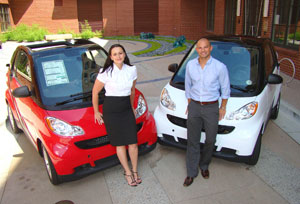
If you’re one of the next seven buyers at Watermark, you can double your mileage zipping around downtown in a SmartCar…free with each purchase. Daimler (Mercedes-Benz) brought them to the U.S. only last year; but they’ve been in Europe ten years now…fuel efficient, and so compact that Italian drivers park them in their car-jammed streets front-end first. At Watermark Sunday July 26, you can get a close look at a new Smart ‘Passion’ convertible; then venture up to the 7th floor ‘Sky Garden’ for appetizers beside the $2 million double-edged infinity pool, and a view over historic Baker neighborhood to the mountains.

samuelson

Fentress, designer of DIA, LAX, Seoul airport, Invesco, and known for sustainable projects, wrapped Watermark’s luxurious suites (from only $275,900) and street-level brownstones (from $595,000) around the Chittenden Mansion at 4th and Acoma Street, a Baker landmark (now the visitor center for Watermark). “This is an extraordinarily well built community that, at this year’s prices, makes for a tremendous value,” says Laura Levy of Crescent Partners, hosting today’s event. “Even without the Smart, people are fortunate to be getting this pricing; it cost more to build this than these prices reflect.”

You can also see how particularly smart this location is for somebody already working in the downtown orbit…maybe at Denver Health, Anthem, or the TV stations, a few blocks away. You can stop by SoBo (the Mayan Theatre, Deluxe, Beatrice & Woodsley, Hornet and other clubs)...and see the amenities residents have on site…not just the pool, but cook-in party lounge and a well equipped fitness center.

Oh yes…and some very contemporary residences and penthouses that all feature rear-hung Euro-styled cabinets, self-closing Blumotion drawers, real Jenn-air appliances, Pella windows and some of the most creative decorating ideas you’ll see at any urban residential offering. Take Broadway south (or Lincoln north) to 4th Avenue, then west.

WHERE:

SmartCar, given to next 7 buyers at Watermark Luxury Residences with purchase; car & show homes on view, appetizers Sun July 26, by rooftop infinity pool. 410 Acoma St., block west of Broadway at 4th. Take Broadway south from downtown to 4th, turn right; or Lincoln north from I-25 to 4th, left.

PRICE:

From $270s, brownstones from $590s, penthouse from $950s

WHEN:

Daily 10 a.m. until 6 p.m., appetizers Sunday Noon-3

PHONE:

303-777-7037

Web:

WatermarkDenver.com

http://www.postnewsrealestate.com/articles/home-page-articles/position-1/watermark-offers-its-next-seven-buyers-a-chance-to-get-smart-in-downtown-appetizers-by-the-rooftop-p/

Out on a limb: Arm-swinging riddle is answered

PARIS (AFP) – Biomedical researchers on Wednesday said they could explain why we swing our arms when we walk, a practice that has long piqued scientific curiosity.

Swinging one's arms comes at a cost. We need muscles to do it, and we need to provide energy in the form of food for those muscles. So what's the advantage?

Little or none, some experts have said, contending that arm-swinging, like our appendix, is an evolutionary relic from when we used to go about on all fours.

But a trio of specialists from the United States and the Netherlands have put the question to rigorous tests.

They built a mechanical model to get an idea of the dynamics of arm-swinging and then recruited 10 volunteers, who were asked to walk with a normal swing, an opposite-to-normal swing, with their arms folded or held by their sides.

The metabolic cost of this activity was derived from oxygen consumption and carbon dioxide (CO2) production as the human guinea pigs breathed in and out.

Arm-swinging turned out to be a plus, rather than a negative, the investigators found.

For one thing, it is surprisingly, er, "'armless" in energy costs, requiring little torque, or rotational twist, from the shoulder muscles.

Holding one's arms as one walks requires 12 percent more metabolic energy, compared with swinging them.

The arms' pendulum swing also helps dampen the bobbly up-and-down motion of walking, which is itself an energy drain for the muscles of the lower legs.

If you hold your arms while walking, this movement, called vertical ground reaction moment, rises by a whopping 63 percent.

Should you prefer to walk with an opposite-to-normal swing -- meaning that your right arm moves in sync with your right leg and your left arm is matched to the motion of your left leg -- the energy cost of using your shoulder muscles will fall.

The downside, though, is that opposite-to-normal swing forces up the metabolic rate by a quarter.

The study, headed by Steven Collins at the University of Michigan at Ann Arbor, says we should give the thumb's-up to arm swinging.

"Rather than a facultative relic of the locomotion needs of our quadrupedal ancestors, arm swinging is an integral part of the energy economy of human gait," says the paper.

It appears in Proceedings of the Royal Society B, the biological research journal of the Royal Society, Britain's de-facto academy of sciences.

http://news.yahoo.com/s/afp/20090728/sc_afp/sciencearmsoffbeat

Entertainment - 'Twilight' Casting News: Bryce Dallas Howard Replacing Rachelle Lefevre In 'Eclipse'

LOS ANGELES, Calif. -- Bryce Dallas Howard is joining the "Twilight" franchise.

The "Terminator Salvation" star will replace Rachelle Lefevre in the role of Victoria, according to Summit Entertainment, which produces the vampire film series based on the books by Stephenie Meyer.

"We are incredibly happy that Bryce has agreed to come into the franchise," Erik Feig, Summit's President of Worldwide Production and Acquisitions, said in a statement to Access Hollywood. "Rachelle brought 'Victoria' to great screen life and Bryce will bring a new dimension to the character. The franchise is lucky to have such a talented actress as Bryce coming in to fill the role."

Summit said Rachelle would not be continuing on as Victoria, an evil vampire out for revenge over the death of her lover, due to scheduling conflicts.

Bryce, the daughter of director Ron Howard, will take over the role beginning in "Eclipse," the third installment in the "Twilight" series.

"Eclipse" begins filming in Vancouver this coming August, Summit confirmed. The film will be released in theaters on June 30, 2010.

by Access Hollywood

http://movies.yahoo.com/feature/access-hollywood-howard-replaces-lefevre.html

Tuesday, July 28, 2009

Tourist Traps that Are Worth It

Tourist traps are to travel as death and taxes are to life: irritating and inescapable. Unless you're making fresh tracks in Siberia, wherever you travel you're bound to find restaurants with cheesy themes or costumed wait staff, historical sites turned into theme parks, even entire cities whose charm and beauty are all but obliterated by camera-wielding tour groups. But not all tourist traps are created equal. Some are authentic, worthwhile experiences … once you scratch beneath the kitsch and push through the crowds. So, go on, you know you want to. Do the tourist thing. Just once.


See More Tourist Traps that Are Worth It


Great Wall, China

Tourist trap cred: An endless line of tour buses clogs the winding roads to Badaling, the section of the Great Wall of China closest to Beijing. Chinese tour groups in matching color-coded caps blanket the stone fortification, and touts hawk everything from panda hats to Great Wall key chains (the more tech-savvy among them will take your picture and produce a copy from a portable backpack printer). Getting tired of climbing the endless stone steps? Just hop on the roller coaster! The rainbow-colored ride winds past the Wall straight to a village of souvenir booths, all selling an identical selection of T-shirts.


Why it's worth it: Even when it's a total sea of humanity, you can't deny the majesty of the more than 5,500 miles that make up the Great Wall, whose stony precipices were created before the advent of power tools (or motor vehicles, for that matter). Badaling is the quickest and easiest way to see the Wall on an excursion from Beijing.


Insider tip: After taking in Badaling's tourist circus, head further afield to unrestored sections like Simatai and Jinshanling. On what's known as the Wild Wall, you can hike undisturbed for several miles along the lush mountain vegetation.


Graceland, Memphis, Tenn.

Tourist trap cred: Graceland delivers with kitsch (note the green shag-carpet ceiling of the "jungle room"), crowds (nearly 600,000 visitors annually), costumes (feel free to bring your own), and, of course, commercialism. In addition to your $28 ticket ($69 for the VIP tour), you can pay homage to the King by purchasing anything from an Elvis Pez dispenser to an Elvis cross-stitch kit, and then gorging on a peanut butter–and-banana sandwich at Rockabilly's Diner.


Why it's worth it: Whether you're packing a sequined jumpsuit or coming armed with a so-bad-it's-good sense of humor, Graceland, which was designated a national historic landmark in 2006, is an integral part of Memphis's illustrious musical heritage. The recording that accompanies the 90-minute mansion tour includes a narration by Lisa Marie and sound bites from Elvis himself. If that doesn't satisfy your curiosity, dig deeper into the mystique by touring Elvis's too-cool car museum and his decked-out private jet, the Lisa Marie.


Insider tip: Paul McLeod's obsessive stash of Elvis memorabilia at nearby Graceland Too — second in size only to Graceland's own collection — is the pinnacle of American fandom, with posters, photos, and every TV Guide cover the King ever appeared on.


Tower of London, London

Tourist trap cred: Tourist trap cred: Almost as legendary as the Tower of London's role in history are the hordes of tourists who plod here to score one of the most famous photo-ops in all of England, gawk at the Beefeaters in their black-and-scarlet 14th-century livery, and spot the ravens (without whose continuous presence, so Charles II was told, the Tower and the kingdom would crumble).


Why it's worth it: It's an ironic twist of history that people now clamor to get into this foreboding stone fortress: William the Conqueror founded it in 1066 to strike fear into the hearts of foreign invaders and unruly subjects. While parts of the experience can be campy (costumed reenactments, for example), the Tower's long and gruesome history is undeniably intriguing; the building itself, perched on the banks of the Thames, is a powerful, stunning sight; and this is your chance to see the Crown Jewels, a collection of 23,578 gems so valuable they're officially beyond price and therefore uninsured. An exhibit of rare arms and armor commemorating the 500th anniversary of Henry VIII's coronation will be on view through January 17, 2010, including a number of suits that trace Henry's progression from slim prince to corpulent monarch.


Insider tip: To attend the Ceremony of the Keys — the Beefeaters' security ritual, which has taken place nightly for over 700 years — you'll have to apply in writing for tickets at least two months in advance (three months for July and August).


Colonial Williamsburg, Va.

Tourist trap cred: At its very core, Colonial Williamsburg is a bizarre gimmick: a perfectly nice Virginia town transformed into a theme park of American history with Renaissance Faire–style role-playing and Disney-caliber price gouging. Scores of costumed townsfolk roam the streets, many industriously engaged in their crafts (merchants, milliners, blacksmiths, innkeepers, printers, bakers), always staying strictly in character, and all wanting to engage you in conversation. Visitors are expected to play along—ordering victuals such as "game pye" and barnyard chicken from mobcapped serving wenches in the taverns, and paying 21st-century prices for reproduction 18th-century jewelry, housewares, and toys.


Why it's worth it: If you haven't been and you're tempted to dismiss Colonial Williamsburg as hokey and inauthentic, think again. Extraordinary execution makes it one of the most entertaining and effective museums in America—and kids dig it, too. The town's 88 original 18th-century buildings are augmented by hundreds more reproduced so faithfully it's hard to tell which are which. Depending on which of the site's four years (1773–76) is being reenacted that day, there may be battles, witch trials, or fife and drum parades. Leave your cynicism in the parking lot, and you'll enjoy every minute of it.


Insider tip: While a full day of time travel will reinvigorate your patriotic spirit, it'll also exhaust your body. The best remedy? A Colonial Herbal Experience at the Spa of Colonial Williamsburg—a two-hour, 18th century–inspired treatment that includes an aromatic footbath, a ginger-and-orange body scrub, an herbal wrap, and a massage.


Venice, Italy

Tourist trap cred: It may be pushing it to damn an entire European city — nay, a major civilization — as a tourist trap, but let's be real: No place on earth is as utterly transformed as Venice is each summer — from a magnificent city of canals, churches, cafés, and art to a seething pit of humanity. Venice has 60,000 full-time residents and an estimated 20 million annual visitors. The Serenest Republic? Not by our standards.


Why it's worth it: Frankly, it's hard to justify a visit in July or August, when tourists jam the bridges, museums, and piazzas. Come in November, however, when fog creeps through the picturesque alleyways and late-afternoon light creates mysterious shadows, and you'll swoon at the romance. This is the time to get to know the real Venice and appreciate its many treasures: the Tintorettos in the Doge's Palace, the Picassos at the Peggy Guggenheim Collection, a glass of wine in a dusky bacaro near the Rialto Market.


Insider tip: The touristy restaurants that line the main streets have done a grave disservice to Venetian cuisine's reputation. For an authentic taste of the city's pasta and seafood dishes, head off the beaten path to eateries like Alle Testiere or Anice Stellato.


New York City Harbor Tours

Tourist trap cred: Since being mistaken for a tourist is an extreme affront to a New Yorker's pride, sightseeing is something that's just not done by the locals. So board a New York Harbor Tour, and you're more likely to end up chatting with John and Susie who flew in from Milwaukee than with anyone who took the subway to the dock.


Why it's worth it: Seeing New York City from the water is a great way to get a handle on the history and geography of the city, and harbor tours provide what's arguably the most impressive view you'll ever get of the Statue of Liberty. Many visitors opt for one of the Circle Line's famous sightseeing boats, but for a more sophisticated, intimate (and slightly pricier) maritime experience, try Shearwater Sailing, which offers morning, afternoon, sunset, and evening tours aboard a magnificent 1920s 82-foot Georgia pine schooner, as well as Sunday brunch and wine-tasting cruises.


Insider tip: The same goes for cruises on the Seine and the Nile — yes, they're touristy, even cheesy, but also fun, informative, and sometimes unforgettable.


Montmartre, Paris

Tourist trap cred: Montmartre is the Paris of romantic cobblestone streets, bohemian cafés, and atmospheric cabarets. Unfortunately, it's also the Paris of street mimes, overpriced restaurants with surly waiters, and mobs and mobs of clueless tourists. Said tourists wield their point-and-clicks most fiercely around the white-domed Sacré-Coeur basilica and the nearby Place du Tertre, the former haunt of Picasso, Modigliani, and Utrillo now occupied by beret-wearing "artists."


Why it's worth it: The reward for climbing the many steps — or if you're lazy, riding the funicular — to Sacré-Coeur, Paris's highest point, is an unrivaled view of the city's rooftops and landmarks. The interior of the Byzantine-style basilica, which includes one of the world's largest mosaics, is worth a look, too. While the area's pervasive nostalgia for the Belle Époque can get tiresome, Montmartre is the birthplace of kitsch entertainment: Its cabarets, dance halls, and ladies-of-the-night have been going at it for more than a century, so taking in a late-night cancan performance at the legendary Moulin Rouge earns you culture points.


Insider tip: Take the Métro to the Abbesses station — note its fabulous Art Nouveau entrance, one of the few remaining in Paris — and browse the food stalls on Rue Lepic for a slice of local life.

By Concierge.com

http://travel.yahoo.com/p-interests-29128892

Science - Could Earth Be Hit, Like Jupiter Just Was?

The recent bruising Jupiter received from a cosmic impact is a violent reminder that our solar system is a shooting gallery that sometimes blasts Earth.

Still, what are the odds of a cosmic impact threatening our planet?

So far 784 near-Earth objects (NEOs) more than a half-mile wide (1 km) have been found.

"If an object of about the same size that just hit Jupiter also hit Earth — it was probably a typical cometary object of a kilometer or so in size (0.6 miles) — it would have been fairly catastrophic," explained astronomer Donald Yeomans, manager of NASA's Near-Earth Object program office at the Jet Propulsion Laboratory in Pasadena, Calif.

Scientists have ruled out the chances of an Earth impact for all of these 784 large NEOs. Still, lesser objects also pose a risk, and researchers estimate more than 100 large NEOS remain to be found.

Small risk

Billions of years ago, impacts were far more common. Our moon retains a record of the pummeling it and Earth took: the moon's craters remain, while on Earth, most scars of ancient impacts have been folded back into the planet or weathered away.

Today's solar system is far less crowded, and in fact Jupiter, having more mass and gravity, scoops up a lot of the dangerous objects, as does the sun.

Currently just one NEO of all the objects scientists are tracking poses any significant chance of hitting the Earth — 2007 VK184. If this roughly 425-foot-wide (130 meters) asteroid hit our planet, it would strike with an energy of roughly 150 million tons of TNT, or more than 10,000 times that of the atom bomb dropped on Hiroshima.

Roughly 100 telescopic observations made so far suggest that 2007 VK184 has a 1-in-2,940 chance of hitting Earth 40 to 50 years from now. However, if the past is any guide, further observations to refine computations of its orbit very likely will downgrade its probability of hitting Earth to virtually nothing, Yeomans said.

Of remaining concern are the NEOs that we do not see. Researchers suspect about 156 large NEOs 1 kilometer in diameter or larger remain to be found, and when it comes to dangerous NEOs in general, "when we get down to 140 meters (460 feet) or larger diameter objects, we think we've discovered about 15 percent of them, and with 50 meters (164 feet) or larger diameter, we've discovered less than 5 percent of them," Yeomans explained.

On average, an NEO roughly a half-mile wide or larger hits the Earth roughly every 500,000 years, "so we're not expecting one anytime soon," Yeomans explained.

"For 500 meters (1,640 feet), we're talking a mean interval of about 100,000 years," he added. "When you get down to 50 meters, the mean interval is about 700 years, and for 30 meters (98 feet), about 140 years or so, but by then you're getting down to a size where you won't expect any ground damage, as they burn up in the atmosphere at about 25 meters (82 feet) in diameter and smaller, probably for an impressive fireball event."

When it comes to truly monstrous NEOs some 10 kilometers (6.2 miles) or larger, of the size thought to have helped kill off the dinosaurs, "that's a 100 million year event, and in fact, I don't think there is anything like that we see right now," Yeomans said. "The largest near-Earth object that can actually cross the Earth's path, Sisyphus, has a diameter of 8 kilometers (5 miles), and the largest that is termed a potential hazard is Toutatis, which has a diameter of approximately 5.4 km (3.35 miles)."

Keeping watch

There are currently four teams worldwide actively looking for both large and small NEOs, Yeomans said. "We're concentrating on the large ones for now, but hopefully with the next generation of search, we'll be more efficient in finding the smaller objects, to find 90 percent of the total population of potential hazards larger than 140 meters," he added.

Keeping an eye on NEOs might not just be healthy for humanity, but also help lead us out into space.

"They're easy objectives to get to, and asteroids have significant metal resources that can be mined, while comets have significant water resources for space habitats or travel," Yeomans said. "If you want to build a habitat in space, you're not going to build it all on the ground and launch it up, since that's too expensive — you want to go up and look for resources instead."

Furthermore, asteroids and comets are among the objects that have changed the least since the birth of the solar system roughly 4.6 billion years ago, and might reveal vital clues behind the mysterious process.

"They may well have delivered the water and carbon-based molecules to Earth that allowed life to form, so they're extremely important for study in that direction," Yeomans added.

Charles Q. Choi

http://news.yahoo.com/s/space/20090728/sc_space/couldearthbehitlikejupiterjustwas

Entertainment - Hulk Hogan, Wife Settle Divorce

Hulk Hogan and his wife have finally reached a settlement in their divorce case.

At a brief hearing Tuesday morning in Clearwater, Fla., Hogan, 55, and his wife Linda announced that they've agreed to the terms of the split.

"We've reached a marital settlement agreement," Ray Rafool, Linda's attorney, told the judge.

In a statement to Usmagazine.com, Hogan's rep says, "Hulk is looking forward to moving on with his life and is very hopeful that he and Linda can maintain a friendship and work together as parents to their two children."

Look back at Hollywood's ugliest splits

The terms were not made public. (In 2008 court filings, the couple's net worth was listed at between $26 million and $32 million.)

Before the proceedings began, Hulk, whose real name is Terry Bollea, and Linda were spotted smiling, according to a local ABC affiliate. At one point, she even kissed his cheek.

"The war is over," Linda said after the hearing.

Check out Hollywood's most expensive splits

Hogan echoed her sentiments, telling the Tampa Tribune: "When you're married to someone for 23 years ... you hope for the best .... We just got torn apart."

Check out more controversial reality show stars

The courtroom scene Tuesday was a stark contrast to the months of bitter feuding.

The two -- who have two kids, Brooke and Nick -- had clashed over everything from money to Linda allowing her younger boyfriend to drive the couple's vehicles. In April, Hulk even remarked to Rolling Stone: "I totally understand OJ. I get it. I could have turned everything into a crime scene, like OJ, cutting everybody's throat."

See famous reality show catfights

Linda, who wed Hogan in 1983, filed for divorce in November 2007. A newspaper reporter broke the news that his wife was divorcing him. "Holy smokes," he said upon hearing the news. "Wow, you just knocked the bottom out of me."

Us Magazine - July 28, 2009 10:23 AM PDT
http://omg.yahoo.com/news/hulk-hogan-wife-settle-divorce/25745?nc

Monday, July 27, 2009

Pandas face uncertain future after China quake

About 35 pandas at a reserve in China's southwestern province of Sichuan face an uncertain future after nearly a quarter of their habitat was destroyed by the powerful earthquake that killed nearly 70,000 people and left 5 million homeless.

BEIJING - About 35 pandas at a reserve in southwestern China face an uncertain future after nearly a quarter of their habitat was destroyed by last year's powerful earthquake that killed nearly 70,000 people, according to a study published Monday.

Large parts of Sichuan province — where most of the world's remaining wild pandas live — were devastated by the massive May 12 earthquake, which sent landslides crashing into river valleys and leaving 5 million homeless.

The landslides and mudflows destroyed 23 percent of the panda's habitat in the south Min mountain region and the remaining bamboo-rich land was left fragmented, potentially threatening the pandas' way of life, said Xu Weihua, the study's lead author and an ecologist with the Chinese Academy of Sciences in Beijing.

By Chi-Chi Zhang


Blue food dye helps heal spinal cord injuries

WASHINGTON - A common and safe blue food dye might provide the best treatment available so far for spinal cord injuries, U.S. researchers reported on Monday.

Tests in rats showed the dye, called brilliant blue G, a close relative of the common food dye Blue no. 1, crossed into the spinal fluid and helped block inflammation, Maiken Nedergaard of the University of Rochester Medical Center and colleagues reported.

"We have no effective treatment now for patients who have an acute spinal cord injury," Dr. Steven Goldman, who worked on the study, said in a statement.

"Our hope is that this work will lead to a practical, safe agent that can be given to patients shortly after injury, for the purpose of decreasing the secondary damage that we have to otherwise expect."

When nerve cells in the brain or spine are damaged, they often release a spurt of chemicals that causes nearby cells to die. No one is sure why, and stopping this process is key to preventing the damage that continues to build after a stroke or spinal cord injury.

One of the chemicals is ATP. Nedergaard's team looked for something that would interfere with this and found the blue dye, which they called BBG, would do this via the P2X7R receptor or doorway.

http://www.msnbc.msn.com/id/32178712/ns/health-more_health_news/

Real Estate - New-home sales soar 11 percent in June

WASHINGTON - New U.S. home sales jumped in June by the largest amount in more than eight years as buyers took advantage of bargain prices, low interest rates and a federal tax credit for first-time homeowners.

While home prices are still falling, the figures released Monday were another sign the housing market is finally bouncing back. Data out last week showed home resales rose 3.6 percent in June, the third straight monthly increase.

Shares of big homebuilders soared on the news, with Beazer Homes USA up by more than 13 percent and Hovnanian Enterprises rising 8 percent. But with home prices still falling, these companies won't be making much money anytime soon.


The Commerce Department said new home sales rose 11 percent in June to a seasonally adjusted annual rate of 384,000, from an upwardly revised May rate of 346,000.

Buyers are rushing to tax advantage of a federal tax credit that covers 10 percent of the home price or up to $8,000 for first-time buyers. Home sales need to be completed by the end of November for buyers to take advantage.

"The window of opportunity is closing," said Bernard Markstein, senior economist for the National Association of Home Builders.

June's results were the strongest sales pace since November 2008 and exceeded the forecasts of economists surveyed by Thomson Reuters, who expected a pace of 360,000 units. The last time sales rose so dramatically was in December 2000.

Sales have risen for three straight months. The median sales price of $206,200, however, was down 12 percent from $234,300 a year earlier and down nearly 6 percent from $219,000 in May.

There were 281,000 new homes for sale at the end of June, down more than 4 percent from May. At the current sales pace, that represents 8.8 months of supply — the lowest level since October 2007. If that number falls to just over 6 months, analysts say, builders will feel more comfortable ramping up construction.

Fallout from the housing crisis has played a central role in the U.S. recession, now the longest since World War II. Foreclosures have spiked, homebuilders have slashed construction, and financial companies have lost billions.

But it will still be a while before homebuilders turn into an engine for the economic recovery. Construction levels are still weak because builders still have too many unsold homes sitting vacant.


http://www.msnbc.msn.com/id/32170761/ns/business-real_estate/

Economics - Sona 2009

Filed Under: State of the Nation Address (SONA), Politics

MY NAME is Melissa Roxas. I’m 31 years old. I was born in Manila, but my family immigrated to the United States when I was young, right after Ninoy was assassinated. My parents said there weren’t many economic opportunities available in the Philippines.

Growing up, I knew I was different from other American kids. When I was older and had a chance to return to the Philippines, I noticed I was different here too. I didn’t have a vivid memory of the Philippines, but I remember questioning why we had to be separated – why we had to leave and immigrate. I wanted to find out more about the world: why there was poverty, why there was inequality. If you asked me what I wanted to be then, I’ll say I knew I wanted to do something that would be important, that would make – not necessarily an impact – but something that would make me feel that I was doing something good in the world.

I was already an activist, but I started being involved with Philippine issues much later on. I’ve always felt close to health care issues, and one of the places I remember going to was Payatas. The Philippines I saw in Payatas was very different from the Philippines I saw when my relatives took me around. Ever since that trip I’ve been going back and forth the United States and the Philippines for missions. Being in the Philippines and having that experience means you can’t ignore the human rights aspect of it. People who want to change what’s going on become targets. Many of them are killed, or are disappeared. I started getting involved in human rights missions.

I was in La Paz, Tarlac on May 19, 2009. We had been doing health care surveys in the community, and had slept over. We were just there resting that morning, talking, watching a noontime show.

We heard them at the door.

They are telling us to open it. There is a man wearing a white shirt he is the only one without a bonnet he is telling us to open the door and the door is forced open and they come through the front door come through the back door. There are about 15 men and they have long firearms and bonnets on and they try to push us down on the floor with our faces to the ground. I keep saying no and they push me and start to punch me and they force me to my knees and shove my face to the ground. And then I see Juanito and John Edward and everyone in the house being forced up. And the men tape their mouths, tie blindfolds over eyes. I start resisting. I keep saying my name as hard and as loud as I can. “Melissa Roxas. Melissa Roxas!” I keep thinking, I don’t want to go with these people.

They started dragging me and there was gravel and my nose was bleeding after they punched me and I saw the van, the van outside, there outside, and I put my foot against the side of the van while they were pushing me in. I was doing everything I could because I didn’t want to get in that van because I knew if I got in that van – I just didn’t want to get in the van. I kept yelling my name. They couldn’t get the blindfold on me because I kept ripping it off. They pushed me into the van and handcuffed me and that was the only time they could blindfold me but they couldn’t put the tape on my mouth because I was vomiting. They forced my head down because they didn’t want me to see outside. We drove. And I remember thinking that I didn’t want to panic. I had to remember everything, to keep track of time in my own head. I couldn’t see and I was facing the floor and I was vomiting. Then we were pausing. Gravel. Some kind of road and there was a pause, then the van stopped. Then I thought: This is it they’re going to kill us, this is it. They drove a little. Stopped. I thought the same thing. They told me to step down.

They took me into a cramped cell. They didn’t feed me for the first two days, had me drink only once or twice during that time. I just wanted to not lose it. I was trying very hard to keep track. I kept thinking that I had to think and I was terrified and I would peek under my blindfold and I knew there was someone watching.

The interrogation started early. It was almost round the clock. They took me out of the jail cell to that little place just before you reach the screen door. That was where they beat me. That was where they strangled me. They asked me many things. They were accusing me of being a member of the CPP-NPA and I kept saying I was not. I kept saying, My name is Melissa Roxas, and I want access to a lawyer. I want to talk to a lawyer, that’s all I kept saying. They kept trying to tell me I was part of the CPP-NPA. And then I kept saying, just kept saying, kept saying my name and that I want to see a lawyer. And they said even if you’re here a year you’ll never see a lawyer. We got you clean, no one knows you’re here. You’ll never see a lawyer.

The interrogation never ended. It’s hard to say what the worst was, because everything was worst for me because every minute I was there I thought I was going to die. When they were beating me they put a plastic bag over my head and they put on a first one and then a second one and all I kept thinking was I’m going to die and all I saw was white and I was losing my breath and I remember having, thinking – couldn’t breathe. They started telling me that they were just tools of God to make people return into the fold of the law. And I told them that God can never do that, can never torture people. And I said the only people who can do that are demons. And I told them I didn’t believe them.

I don’t know exactly why I was released. While I was with them I eventually told them that I was a US citizen. Maybe they were afraid of that. They kept telling me, we’re friends right? We’re friends right? You won’t tell anyone what happened?

I don’t want it to happen ever again to anyone, and I want the Philippine government and the Philippine military to be held accountable for what they did to me, and what they are doing to other people. They can’t keep denying it. I am still afraid. Every day, I’m still afraid. But I know what the truth is. I know what happened. I know what I heard. And I know what I saw. And I want to testify.

* * *

Melissa Roxas flew in from the United States last Monday after leaving the country immediately after her release. She returned at the request of the Court of Appeals to testify on her abduction and torture, and is under the protection of the Commission on Human Rights.

ANC’s Storyline features her narrative Sunday at 3:30 p.m.

By Patricia Evangelista
Philippine Daily Inquirer

http://opinion.inquirer.net/inquireropinion/columns/view/20090726-217249/Sona-2009

Sunday, July 26, 2009

Investor Report: Bankruptcy Filings

Tax-deferred real estate exchange investors who've been victims of bankruptcy filings by intermediary companies in recent months could be in for some relief from the IRS.


In a letter to Senator Chris Dodd of Connecticut, chairman of the Senate Banking Committee, the IRS said it is aware of the financial pain, and potentially severe tax liabilities, faced by Section 1031 exchange investors around the country.

Among the most prominent recent bankruptcy filings that have interfered with thousands of exchanges: Land America 1031 Exchange Services, Inc., a subsidiary of title insurance giant Land America; and Summit Accommodators.

In both cases, the intermediary firms were holding millions of dollars of exchange participants' money, which were then frozen by the bankruptcy filings.

So-called "qualified intermediaries," or "QIs", play a pivotal role in tax-deferred exchanges. They hold the proceeds of investors' transactions in escrow while the investors are locating replacement properties to qualify for federal tax deferral.

During that interim period, the investors have no access to the escrowed funds. Though many QIs deposit escrowed funds into FDIC-insured bank accounts, some exchange agreements do not require that.

In the case of Summit, for instance, the company reportedly had lent millions of dollars of investors' escrow money to an affiliate , which in turn invested it into real estate ventures.

At the time of the bankruptcy filing, roughly $14.2 million in investors' money reportedly was missing -- making it impossible for them to acquire replacement properties to complete their tax-free exchanges.

More than $419 million in investors' escrowed money was tied up in the LandAmerica filing, exposing hundreds of investors to potential capital gains taxes because their exchanges could not be completed.

In its letter to Dodd, the IRS said it has no statutory authority to extend Section 1031 deadlines to accommodate investors harmed by QI bankruptcies. But it indicated that it is "considering some type of relief for taxpayers in this situation." The letter did not say what types of relief might be in the cards. "Investors are really in a tough spot," said Mary Foster, a past president of the Federation of Exchange Accommodators, a 1031 industry group.

Bill Horan of Realty Exchange Corp.in Gainesville, Virginia, told Realty Times there's a second category of investors who need help: victims of outright fraud, where QIs "took the (escrowed) money for themselves."

Ed Okun of Miami, who ran multiple QI firms, was convicted in March of defrauding hundreds of exchange investors of $126 million in a Ponzi scheme where funds allegedly were used for Okun's personal activities - including a divorce settlement and purchase of a 131-foot megayacht.

by Kenneth R. Harney

Real Estate - Pre sold Property Offers Confusing Sale Status

Remember the largest home sale to close in Pulaski County during 2007?

It was a whopper, in more ways than one, at $3.5 million.

Don't feel bad if you don't recall the sale of the 10,000-SF residence in west Little Rock's Chenal Downs neighborhood.

Neither did we.

That's because there was no $3.5 million real estate transaction.


The only deed connected to the property since the house was built was filed back in June 2005.

That's when Steve Landers Jr. and his wife, Karmen, bought the undeveloped lot for $183,000 from Rick Ferguson Inc.

How does an upscale lot sale get transformed into a $3.5 million house sale in the database at Cooperative Arkansas Realtors Multiple Listing Services Inc.?

That sounded like a question for Toni Fryar at the Bryant office of Crye-Leike Realtors, the listing and selling agent for the property.

Fryar explained that the residence was "presold," indicating that the house-to-be-built was tied to the lot sale.

The "sale" of the house didn't hit the CARMLS database until construction was completed in 2007.

Steve Landers Jr. wasn't familiar with the presold arrangement connected with the house built on the lot he purchased, and Ferguson couldn't be reached for comment.

http://www.toprealtynews.com/realestatenews/id_54709/

Science - Solar Eclipse, New Dragon Species, and a Prehistoric Blast: Buzz Week in Review

Corruption probes, presidential regrets, and other breaking news occupied headlines this week, but a mighty big science phenomena dwarfed those earthly concerns. After a busy seven days, take a look at the latest—and some ancient news, too—in the Buzz Week in Review.

An eclipse to remember
Earthlings won't see another solar eclipse like the one that darkened Asia this week for another 123 years, but that's soon enough for some. Millions ventured outside to enjoy the six-minute plus blackout, with astronomy experts gathering in Shanghai (which reportedly offered the "best views"), Japanese party planners setting up a music festival for the occasion, and passengers chartering a plane in India for a closer view. The prospect of being submerged in darkness, though, unleashed old superstitions, as some shut themselves indoors, cleansed their sins in the Ganges River, or prayed against bad omens. The event may have come and gone, but video and photos abound.

Another new Dragon species?
The Komodo dragon has had a busy year. First, studies of its venomous bite upgraded the lizard to an elite poisonous group occupied only by the Gila monster and the Mexican beaded lizard. Now the Komodo's got new kin: German scientists stumbled upon a new (to human beings) species of mangrove monitor lizard in the Talaud Islands. The discovery of the Varanus lirungensis (which is also related to the crocodile monitor) points to a huge predator diversity in Indonesia. So watch where you step!

The other big bang?
The theory about space rocks wiping out Ice Age species just got another boost: It turns out the first human inhabitants may have also been hit. Rare "nano-sized diamonds" that form under extremely hot fires are evidence that space rocks hit the North American continent about 13,000 years ago. Unfortunately, some pygmy mammoth (a smaller version of the woolly mammoth) and a group called the Clovis people happened to be in the line of fire. The galactic slam, plus "overhunting and climate change," created what one researcher called a "perfect storm" that wiped out the Ice Age population. The findings swelled searches on Yahoo! for the prehistoric "clovis people," so named because of artifacts first found in Clovis, New Mexico. For more on the mastodon hunters and the first Americans, check out this 2007 LiveScience article.

Also buzzing this week...

by Vera H-C Chan
http://buzz.yahoo.com/buzzlog/92849/?fp=1

Thursday, July 23, 2009

100 Things Your Kids May Never Know About

There are some things in this world that will never be forgotten, this week’s 40th anniversary of the moon landing for one. But Moore’s Law and our ever-increasing quest for simpler, smaller, faster and better widgets and thingamabobs will always ensure that some of the technology we grew up with will not be passed down the line to the next generation of geeks.

That is, of course, unless we tell them all about the good old days of modems and typewriters, slide rules and encyclopedias …

Photo Credit: makelessnoise via flickr

Photo credit: makelessnoise via flickr

Audio-Visual Entertainment

  1. Inserting a VHS tape into a VCR to watch a movie or to record something.
  2. Super-8 movies and cine film of all kinds.
  3. Playing music on an audio tape using a personal stereo. See what happens when you give a Walkman to today’s teenager.
  4. The number of TV channels being a single digit. I remember it being a massive event when Britain got its fourth channel.
  5. Standard-definition, CRT TVs filling up half your living room.
  6. Rotary dial televisions with no remote control. You know, the ones where the kids were the remote control.
  7. High-speed dubbing.
  8. 8-track cartridges.
  9. Vinyl records. Even today’s DJs are going laptop or CD.
  10. Betamax tapes.
  11. MiniDisc.
  12. Laserdisc: the LP of DVD.
  13. Scanning the radio dial and hearing static between stations. (Digital tuners + HD radio b0rk this concept.)
  14. Shortwave radio.
  15. 3-D movies meaning red-and-green glasses.
  16. Watching TV when the networks say you should. Tivo and Sky+ are slowing killing this one.
  17. That there was a time before ‘reality TV.’
  18. Computers and Videogaming

  19. Wires. OK, so they’re not gone yet, but it won’t be long
  20. The scream of a modem connecting.
  21. The buzz of a dot-matrix printer
  22. 5- and 3-inch floppies, Zip Discs and countless other forms of data storage.
  23. Using jumpers to set IRQs.
  24. DOS.
  25. Terminals accessing the mainframe.
  26. Screens being just green (or orange) on black.
  27. Tweaking the volume setting on your tape deck to get a computer game to load, and waiting ages for it to actually do it.
  28. Daisy chaining your SCSI devices and making sure they’ve all got a different ID.
  29. Counting in kilobytes.
  30. Wondering if you can afford to buy a RAM upgrade.
  31. Blowing the dust out of a NES cartridge in the hopes that it’ll load this time.
  32. Turning a PlayStation on its end to try and get a game to load.
  33. Joysticks.
  34. Having to delete something to make room on your hard drive.
  35. Booting your computer off of a floppy disk.
  36. Recording a song in a studio.
  37. Photo credit: ghbrett via flickr

    Photo credit: ghbrett via flickr

    The Internet

  38. NCSA Mosaic.
  39. Finding out information from an encyclopedia.
  40. Using a road atlas to get from A to B.
  41. Doing bank business only when the bank is open.
  42. Shopping only during the day, Monday to Saturday.
  43. Phone books and Yellow Pages.
  44. Newspapers and magazines made from dead trees.
  45. Actually being able to get a domain name consisting of real words.
  46. Filling out an order form by hand, putting it in an envelope and posting it.
  47. Not knowing exactly what all of your friends are doing and thinking at every moment.
  48. Carrying on a correspondence with real letters, especially the handwritten kind.
  49. Archie searches.
  50. Gopher searches.
  51. Concatenating and UUDecoding binaries from Usenet.
  52. Privacy.
  53. The fact that words generally don’t have num8er5 in them.
  54. Correct spelling of phrases, rather than TLAs.
  55. Waiting several minutes (or even hours!) to download something.
  56. The time before botnets/security vulnerabilities due to always-on and always-connected PCs
  57. The time before PC networks.
  58. When Spam was just a meat product — or even a Monty Python sketch.
  59. Photo credit: Chris Devers via flickr

    Photo credit: Chris Devers via flickr

    Gadgets

  60. Typewriters.
  61. Putting film in your camera: 35mm may have some life still, but what about APS or disk?
  62. Sending that film away to be processed.
  63. Having physical prints of photographs come back to you.
  64. CB radios.
  65. Getting lost. With GPS coming to more and more phones, your location is only a click away.
  66. Rotary-dial telephones.
  67. Answering machines.
  68. Using a stick to point at information on a wallchart
  69. Pay phones.
  70. Phones with actual bells in them.
  71. Fax machines.
  72. Vacuum cleaners with bags in them.
  73. Photo credit: ansik via flickr

    Photo credit: ansik via flickr

    Everything Else

  74. Taking turns picking a radio station, or selecting a tape, for everyone to listen to during a long drive.
  75. Remembering someone’s phone number.
  76. Not knowing who was calling you on the phone.
  77. Actually going down to a Blockbuster store to rent a movie.
  78. Toys actually being suitable for the under-3s.
  79. LEGO just being square blocks of various sizes, with the odd wheel, window or door.
  80. Waiting for the television-network premiere to watch a movie after its run at the theater.
  81. Relying on the 5-minute sport segment on the nightly news for baseball highlights.
  82. Neat handwriting.
  83. The days before the nanny state.
  84. Starbuck being a man.
  85. Han shoots first.
  86. “Obi-Wan never told you what happened to your father.” But they’ve already seen episode III, so it’s no big surprise.
  87. Kentucky Fried Chicken, as opposed to KFC.
  88. Trig tables and log tables.
  89. “Don’t know what a slide rule is for …”
  90. Finding books in a card catalog at the library.
  91. Swimming pools with diving boards.
  92. Hershey bars in silver wrappers.
  93. Sliding the paper outer wrapper off a Kit-Kat, placing it on the palm of your hand and clapping to make it bang loudly. Then sliding your finger down the silver foil to break off the first finger
  94. A Marathon bar (what a Snickers used to be called in Britain).
  95. Having to manually unlock a car door.
  96. Writing a check.
  97. Looking out the window during a long drive.
  98. Roller skates, as opposed to blades.
  99. Cash.
  100. Libraries as a place to get books rather than a place to use the internet.
  101. Spending your entire allowance at the arcade in the mall.
  102. Omni Magazine
  103. A physical dictionary — either for spelling or definitions.
  104. When a ‘geek’ and a ‘nerd’ were one and the same.
By Nathan Barry
http://www.wired.com/geekdad/2009/07/100-things-your-kids-may-never-know-about?npu=1&mbid=yhp

Real Estate - Home Sales, All Over the Map

Memo to those wondering when the housing slump will end: It depends on where you live.

The Wall Street Journal's latest quarterly survey of housing-related data shows that the market for residential real estate is healing at varying speeds in different parts of the country. The Northern Virginia suburbs of Washington, D.C., and many areas in California that are near employment centers have shown signs of stabilizing, housing analysts say, while the outlook in other places -- much of Florida, Detroit and Las Vegas -- still appears bleak.

Thursday morning's report from the National Association of Realtors on June home sales is sure to inflame the debate on whether the housing market is bottoming, but clear answers are likely to remain elusive -- partly because of the variations in performance around the nation.

In June, home sales were up sharply from the depressed year-earlier levels in Orlando, Minneapolis, Southern California and the San Francisco Bay Area, according to reports from local Realtor groups and MDA DataQuick, a research firm. But sales dropped 50% in Manhattan, according to Miller Samuel Inc., a New York-based appraisal firm. Sales also declined in Long Island, N.Y., and Charlotte, N.C., among other areas.

A flood of foreclosed homes sold by banks over the past year has crushed prices of low- to mid-range houses down to levels that attract investors and first-time buyers in some areas, notably parts of California.

For Amy Musial, who manages a Starbucks in Sacramento buying a house became "a no-brainer" this spring once she and her husband realized that their monthly payments would be slightly lower than the rent they had been paying on a two-bedroom apartment. They paid about $229,000 for a three-bedroom house that had been through a foreclosure. Several years ago, the same house could have sold for more than $350,000, estimates Shelley Hescock, the real-estate agent who represented the Musials.

But prices of higher-end homes around the country have been slower to fall because there have been fewer foreclosure sand other forced sales of such properties. That is changing as more owners of fancy homes lose jobs, fall behind on mortgages or chop asking prices to realistic levels.

At both the high and low ends of the market, there are still plenty of reasons for caution. Rising unemployment is removing potential buyers and turning others into sellers. Credit remains tight. Appraisers have become more conservative and their estimates are causing many potential sales to fall through. Large numbers of foreclosed homes are likely to weigh on the market for at least another year or two. And a federal tax credit of as much as $8,000 for first-time home buyers ends Nov. 30.

"People are being more conservative with what they're buying," says Matthew Montgomery, a real-estate agent at Hammond Residential who works in the Boston suburbs of Newton and Brookline, Mass. In general, he adds, "the bigger the house, the harder it is to sell."

In the Washington, D.C., area, government-related employment has held up and helped revive housing demand, says Jody Kahn, an analyst at John Burns Real Estate Consulting, a research firm. "Good locations in Alexandria and Fairfax [Va.] are seeing some emerging price stability and even small increases," Ms. Kahn says, and Maryland's Montgomery County "is showing price stability." More remote suburbs will take longer to recover, she says.

In California, San Diego and Sacramento both have become much more affordable, she says. Ms. Kahn also thinks prospects are relatively good in Denver; Raleigh, N.C.; San Jose, Calif.; and the Texas cities of Austin and San Antonio -- areas that generally avoided the housing bubble and so don't have as much need to adjust.

Thomas Lawler, an independent housing economist in Leesburg, Va., says areas that seem to be nearing stability include San Diego, Sacramento, Minneapolis, Boston and the Virginia suburbs of Washington.

Among metro areas that "still have a long road to recovery" are Detroit, Phoenix, Las Vegas, Miami-Fort Lauderdale and Chicago, says Ms. Kahn. Mr. Lawler includes New York, Seattle and Portland, among others, in this category. Problems in these areas include high unemployment and large numbers of vacant homes.

Of course, there are lots of variations within metro areas. The most appealing neighborhoods, offering short commutes and good schools, may vastly outperform marginal areas that thrived during the boom.

The job market outlook is a major wild card for those seeking to divine the direction of house prices. Looking ahead one year, Moody's Economy.com sees the metro areas of Washington, Minneapolis, Houston and Dallas among those likely to have unemployment rates below the national average. Those expected to be above the national average include Detroit, Las Vegas, Los Angeles, Miami, Orlando, Sacramento and Portland, Ore.

Unemployment may be the most important factor in assessing a metro area's housing-market prospects, says Mark Zandi, chief economist at Moody's Economy.com. "If people don't have jobs or fear losing their jobs ,then buying homes is out of the question," he says.

provided by
wsjlogo.gif

by James R. Hagerty

Memo to those wondering when the housing slump will end: It depends on where you live.

The Wall Street Journal's latest quarterly survey of housing-related data shows that the market for residential real estate is healing at varying speeds in different parts of the country. The Northern Virginia suburbs of Washington, D.C., and many areas in California that are near employment centers have shown signs of stabilizing, housing analysts say, while the outlook in other places -- much of Florida, Detroit and Las Vegas -- still appears bleak.

Thursday morning's report from the National Association of Realtors on June home sales is sure to inflame the debate on whether the housing market is bottoming, but clear answers are likely to remain elusive -- partly because of the variations in performance around the nation.

In June, home sales were up sharply from the depressed year-earlier levels in Orlando, Minneapolis, Southern California and the San Francisco Bay Area, according to reports from local Realtor groups and MDA DataQuick, a research firm. But sales dropped 50% in Manhattan, according to Miller Samuel Inc., a New York-based appraisal firm. Sales also declined in Long Island, N.Y., and Charlotte, N.C., among other areas.

A flood of foreclosed homes sold by banks over the past year has crushed prices of low- to mid-range houses down to levels that attract investors and first-time buyers in some areas, notably parts of California.

For Amy Musial, who manages a Starbucks in Sacramento buying a house became "a no-brainer" this spring once she and her husband realized that their monthly payments would be slightly lower than the rent they had been paying on a two-bedroom apartment. They paid about $229,000 for a three-bedroom house that had been through a foreclosure. Several years ago, the same house could have sold for more than $350,000, estimates Shelley Hescock, the real-estate agent who represented the Musials.

But prices of higher-end homes around the country have been slower to fall because there have been fewer foreclosure sand other forced sales of such properties. That is changing as more owners of fancy homes lose jobs, fall behind on mortgages or chop asking prices to realistic levels.

At both the high and low ends of the market, there are still plenty of reasons for caution. Rising unemployment is removing potential buyers and turning others into sellers. Credit remains tight. Appraisers have become more conservative and their estimates are causing many potential sales to fall through. Large numbers of foreclosed homes are likely to weigh on the market for at least another year or two. And a federal tax credit of as much as $8,000 for first-time home buyers ends Nov. 30.

"People are being more conservative with what they're buying," says Matthew Montgomery, a real-estate agent at Hammond Residential who works in the Boston suburbs of Newton and Brookline, Mass. In general, he adds, "the bigger the house, the harder it is to sell."

In the Washington, D.C., area, government-related employment has held up and helped revive housing demand, says Jody Kahn, an analyst at John Burns Real Estate Consulting, a research firm. "Good locations in Alexandria and Fairfax [Va.] are seeing some emerging price stability and even small increases," Ms. Kahn says, and Maryland's Montgomery County "is showing price stability." More remote suburbs will take longer to recover, she says.

In California, San Diego and Sacramento both have become much more affordable, she says. Ms. Kahn also thinks prospects are relatively good in Denver; Raleigh, N.C.; San Jose, Calif.; and the Texas cities of Austin and San Antonio -- areas that generally avoided the housing bubble and so don't have as much need to adjust.

Thomas Lawler, an independent housing economist in Leesburg, Va., says areas that seem to be nearing stability include San Diego, Sacramento, Minneapolis, Boston and the Virginia suburbs of Washington.

Among metro areas that "still have a long road to recovery" are Detroit, Phoenix, Las Vegas, Miami-Fort Lauderdale and Chicago, says Ms. Kahn. Mr. Lawler includes New York, Seattle and Portland, among others, in this category. Problems in these areas include high unemployment and large numbers of vacant homes.

Of course, there are lots of variations within metro areas. The most appealing neighborhoods, offering short commutes and good schools, may vastly outperform marginal areas that thrived during the boom.

The job market outlook is a major wild card for those seeking to divine the direction of house prices. Looking ahead one year, Moody's Economy.com sees the metro areas of Washington, Minneapolis, Houston and Dallas among those likely to have unemployment rates below the national average. Those expected to be above the national average include Detroit, Las Vegas, Los Angeles, Miami, Orlando, Sacramento and Portland, Ore.

Unemployment may be the most important factor in assessing a metro area's housing-market prospects, says Mark Zandi, chief economist at Moody's Economy.com. "If people don't have jobs or fear losing their jobs ,then buying homes is out of the question," he says.

provided by
wsjlogo.gif

by James R. Hagerty

Wednesday, July 22, 2009

Real estate checklists gone wild

A hundred years ago, I was in college. After a long and deliberate process of considering viable fields of study (involving a thoughtful analysis of the boy-to-girl ratios of each), I chose civil engineering. Engineering, it turns out, indeed involved a lot of boys but also a lot of numbers.

Mostly, though, it involved a lot of rules, or as we called them, equations. Remember the right equation for the right situation; plug; and play. That's how I tended to approach it. But then there was Sherman. He was in a different area of engineering -- the magic kind where you had to take certain things on faith, like the fact that a bunch of random wires carrying who-knows-what could actually power a blow-dryer -- or Bill Gates.

And maybe it was because of the more conceptual nature of his classes that Sherman didn't bother with memorizing the equations. He didn't rely on rules for finishing his homework. He just looked at the problem, started with what he knew to be true (those stupid numbers), and developed the solutions himself.

In 1983, Sherman was hired by a little start-up company that rhymes with "Qualcomm" and today is reportedly sipping fruity drinks on his own Mediterranean island. I eventually became a real estate agent. I will let you draw your own conclusions, but that's not the point.

Or maybe it is. The real estate industry is a big, bureaucratic, afraid-of-being-sued machine. So our brokers have their own equations: prescriptive procedures that we are required to follow in completing our homework. The gold star is the paycheck, and in order to get one of those things, most brokers thump their agents upside their heads with checklists until all of the basic reasoning skills run out both ears.

It all boils down to problems and solutions. Where checklists are concerned, the solution is always the same regardless of the actual problem, and that becomes the problem in itself. Pretty soon you find that you have established a culture of soldiers responding to executive orders instead of an organization of innovative, critical thinkers. And then we wonder why students in our major tend to fall a little to the left of the progressive curve.

That was a big lead-in to a small nit I have to pick, but come on, people. Think! Take our disclosures. Yes, we need them. Yes, many are statutory mandates. No, horizontal stripes are not becoming. But, don't be afraid to put on the old thinking cap once in awhile!

My favorite examples of real estate by rote come after closing. I recently got a call from an agent saying she had misplaced the buyer's loan prequalification letter. She needed it for her file ... in order to get paid. At this point, I am asking myself, "Why?"

The loan has funded. The deed has recorded. The buyer has already exchanged all of the socket wrench sets he received at his housewarming party for several bottles of tequila. Is there any question that he is qualified to get financing?

BUYER: "Your Honor, I submit that my home purchase should be voided and that I am entitled to damages because there is no evidence in the file that I am qualified for a loan."

JUDGE: "But you got a loan! On the other hand, there was a checklist. The court awards the plaintiff $40 million and a week on Sherman's island for pain and suffering."

One of my ongoing battles with the rational-thinking impaired is a California disclosure called the Seller's Property Questionnaire. This is a little disclosure that grew from three pages to four a couple of years ago. In doing so, it incorporated another disclosure, the Supplemental Statutory and Contractual Disclosures. At the risk of boring the socks off of you, the point is that today, if you use the former, you are also in effect using the latter.

It is a tidy little twofer deal. Except, in about half of our transactions, I get an 11th-hour call from the agent or their transaction coordinator saying they need both for their files in order to get paid. Forget that they really have both; they also have a checklist with an invisible yet implied advisory at the bottom cautioning against independent thought. The checklist always wins.


http://www.inman.com/buyers-sellers/columnists/krisberg/real-estate-checklists-gone-wild