Monday, August 31, 2009

The World's Best-Paid Cities

Residents of Swiss financial center Zurich know that their country has more to offer than world-class chocolate and precision watches. They can now brag that, on the whole, they earn more than anyone in the world. Zurich-dwellers rake in $22.60 per hour in average net pay, according to a wage survey released August 19. The runner-up city is less than 200 miles southwest: Geneva, where jobs pay $20.40 per hour.

Though the Swiss cities provide the most cash to workers, they are not the most expensive locales for employers to set up shop. Laborers in glittering Copenhagen command the highest gross pay, at an average of $32.80 per hour.

Employees in Zurich and Geneva not only take home top dollar, they can buy the most with their earnings. When you factor in local prices, they blow away any other international city in terms of what workers can get for their money.

Working life in Mumbai marks the other end of the spectrum. Because of its $1.20 average hourly wage, the impoverished urban center trails the list of 73 cities compiled in the Prices and Earnings report, released by every three years.

Behind The Numbers

UBS arrived at its rankings by studying the wages, taxes and working hours of 14 occupations across 73 world cities. Schoolteachers have a very different lifestyle in Berlin, where they earn an average of $35,800 per year after taxes, than they do in Bucharest, where the same work nets them only $4,100. A female factory worker brings in $18,200 in Chicago, but less than a tenth of that--$1,800--in Cairo.

To accurately measure each city's quality of life, the researchers looked not only at gross salaries, but what workers brought home after taxes, based on the number of hours typically worked in their city.

To determine how far citizens could stretch this amount, they then calculated the cost of a generic shopping basket, comprising 154 commonly consumed products and services in each city. The basket was priciest in Oslo, at $112.

"The prices of goods are higher in Oslo because it's relatively remote, it's expensive for companies to operate there, and because taxes are high," says Robert Helsley, a professor at the University of California, Berkeley's Haas School of Business.

In Sydney, the same essentials cost a more reasonable $68.50, but the cheapest goods could be found in two Indian Cities: Delhi and Mumbai, where the shopping basket costs $37.60 and $30.90, respectively.

A Parisian can buy 61.3 baskets with their annual net income, but a Peruvian living in Lima can only afford 32.4 with theirs.

To crystallize the meaning of earnings in different countries, the study introduced a contemporary but ubiquitous item to the basked of goods--an iPod Nano. Taking into account pay, taxes and the price of goods, workers in Cairo would have to toil for 105 hours to get their hands on one of the MP3 players, while those in Zurich and New York can pick one up after working for the least amount of time of all the countries surveyed: 9 hours--roughly a day's work.

Europeans Rake In The Most

The list was crowded with European cities: 14 of the 20 wallet-fattening cities were Western European capitals. All four of the American cities that were included in the analysis made the top 20: New York, Los Angeles, Miami and Chicago. But two other cosmopolitan North American cities, Montreal and Mexico City, didn't make the cut--in fact, Mexico City was one of the lowest-earning of all those surveyed, beating only Delhi, Manila, Jakarta and Mumbai in wages earned. The top 20 includes one city each from the Asian and Australian continents--Tokyo and Sidney.

The dominance of European cities in the rankings is partly a function of sample: there are more of them on the overall list. But that's not the only reason. During the earnings periods for which most companies reported--roughly the 2008 calendar year--the dollar depreciated significantly to the Euro.

Switzerland specifically fared well because of its strong financial services sector and small size.

"Industry obviously influences what the overall compensation will be," says Michael Ryan, chief investment strategist for Swiss bank UBS' wealth management unit, which produced the report. "Switzerland tends to have very specialized products, and financial services."

But the tumultuous global economy, whose effect may not be fully reflected in these numbers, may soon knock financial centers like Zurich, Geneva and New York from the top spots. "As we see impact of global financial crisis play out, will that have an emphasis on reordering the list?" says Ryan. "We won't get that from this data. It's too fresh."

Big Pay Packages In Copenhagen, but More Free Cash In Dublin

Even though employers in some cities seemed to offer impressive-looking wages, workers in lower-earning cities often had much more of their checks left over to play with after taxes and other contributions.

Copenhagen had the biggest disparity between gross and net pay; its workforce contributes 46% of salaries to taxes and social security, shrinking the average paycheck from $32.80 per hour to $17.70. Those cashing their paychecks in Munich, Amsterdam, Oslo and Frankfurt give the next-highest chunks of income to the government.

But taxes fund distinct benefits in different parts of the world, so a strict comparison of tax burdens doesn't give the whole picture.

"Tax systems provide very different public services in different cities. In Copenhagen, I'm assuming health care is included in public tax contributions. In Los Angeles it wouldn't be," says Helsley. "Public safety, the quality of the public transportation system, lots of things could be influenced by government spending that would be germane to a person's choice of place to live."

There's no doubt that a sweet compensation package does a great deal to lure workers to any international location. But salary isn't everything. Employers determining where to locate their businesses and workers deciding where to live must consider a lot more. "Looking at just earnings is deceptive," says Helsley. "The same person is not going to locate in Mexico and Helsinki." Just because a city makes the top five, "It doesn't say it's the best place to locate a firm, and it certainly doesn't mean it's the best place to be a worker."

Top 5 World's Best-Paid Cities

1. Zurich, Switzerland

zurich.jpg
AP Photo / Joachim Ladefoged/VII

Net pay per hour: $22.60

Gross pay per hour: $30.30

Tax and Social Security contributions: 46%

Vacation days: 23

Working time for an iPod Nano: 9 hours


2. Geneva, Switzerland

geneva.jpg
AP Photo/Anja Niedringhaus

Net pay per hour: $20.40

Gross pay per hour: $29.20

Tax and Social Security contributions: 30%

Vacation days: 23

Working time for an iPod Nano: 10 hours


3. New York

new-york.jpg
Brasil 2/iStockphoto.com

Net pay per hour: $19

Gross pay per hour: $26.10

Tax and Social Security contributions: 28%

Vacation days: 12

Working time for an iPod Nano: 9 hours


4. Dublin

dublin.jpg
Niall Carson/PA Wire via AP Images

Net pay per hour: $18.70

Gross pay per hour: $22

Tax and Social Security contributions: 15%

Vacation days: 21

Working time for an iPod Nano: 10 hours


5. Luxembourg

lux.jpg
AP Photo/ Luxpress/Manuel Dias HA

Gross pay per hour: $22.40

Net pay per hour: $18.20

Tax and Social Security contributions: 18%

Vacation days: 25

Working time for an iPod Nano: 10 hours


by Francesca Levy

WPA encryption cracked in one minute

The second generation of Wi-Fi security systems has now been broken as badly as its notoriously insecure predecessor: Japanese researchers say they can crack WPA (Wi-Fi Protected Access), the successor to the old-school WEP, inside of a minute's time spent eavesdropping on a wireless network.

Details on the mechanics of the attack are set to be announced next month at a computer conference, but it's tentatively described as taking to "a new level" the previous method by which WPA had been roughly compromised, adapting previously theoretical holes in the WPA system and turning them into practical attack techniques.

The previous method of attacking WPA devices took up to 15 minutes to be successful, and didn't always work. The new method is said to work on far more devices and, obviously, much more quickly. However, as with the old attack, the new one only works on WPA devices that use the TKIP (Temporal Key Integrity Protocol) algorithm, which is a setting in your router and device setup.

WPA devices that use the newer AES (Advanced Encryption Standard) algorithm, plus devices that use WPA2 -- the third generation of wireless security standards -- are still safe for now.

However, this does mean that it won't be long before this attack technique trickles out into software that malicious hackers can use to invade WPA networks. With access to your wireless network, a hacker can potentially eavesdrop on any traffic sent, access shared folders on computers attached to the network, and of course send and receive data (like illegal file sharing or even child pornography) which could then be blamed on you.

To protect yourself, upgrade the security settings on your devices to WPA2 if they all support the standard. Alternately, you can upgrade any WPA device from TKIP security to AES. Check in your router administration console and on your computer for and where how to do this.

http://tech.yahoo.com/blogs/null/147906;_ylt=AmfsmDqYp.m8KGaUpE6fIW2CfNdF

Pacific Ocean garbage patch worries researchers

LOS ANGELES – A tawny stuffed puppy bobs in cold sea water, his four stiff legs tangled in the green net of some nameless fisherman.

It's one of the bigger pieces of trash in a sprawling mass of garbage-littered water, known as the Great Pacific Garbage Patch, where most of the plastic looks like snowy confetti against the deep blue of the north Pacific Ocean.

Most of the trash has broken into bite-sized plastic bits, and scientists want to know whether it's sickening or killing the small fish, plankton and birds that ingest it.

During their August fact-finding expedition, a group of University of California scientists found much more debris than they expected. The team announced their observations at a San Diego press conference Thursday.

"It's pretty shocking — it's unusual to find exactly what you're looking for," said Miriam Goldstein, who led fellow researchers from the Scripps Institution of Oceanography at UC San Diego on the three-week voyage.

While scientists have documented trash's harmful effects for coastal marine life, there's little research on garbage patches, which were first explored extensively by self-trained ocean researcher Charles Moore just a decade ago. There's also scant research on the marine life at the bottom of the food chain that inhabit the patch.

But even the weather-beaten, sunbleached plastic flakes that are smaller than a thumbnail can be alarming.

"They're the right size to be interacting with the food chain out there," Goldstein said.

The team also netted occasional water bottles with barnacles clinging to the side. Some of the trash had labels written in Chinese and English, hints of the long journeys garbage takes to arrive mid-ocean.

Plastic sea trash doesn't biodegrade and often floats at the surface. Bottlecaps, bags and wrappers that end up in the ocean from the wind or through overflowing sewage systems can then drift thousands of miles.

The sheer quantity of plastic that accumulates in the North Pacific Gyre, a vortex formed by ocean and wind currents and located 1,000 miles off the California coast, has the scientists worried about how it might harm the sea creatures there.

A study released earlier this month estimated that thousands of tons of plastic debris wind up in the oceans every year, and some of that has ended up in the swirling currents of the Great Pacific Garbage Patch.

Katsuhiko Saido, a chemist at Nihon University, Chiba, Japan, told the annual meeting of the American Chemical Society last week that plastic actually does decompose, releasing potentially toxic chemicals that can disrupt the functioning of hormones in animals and marine life.

The Scripps team hopes the samples they gathered during the trip nail down answers to questions of the trash's environmental impact. Does eating plastic poison plankton? Is the ecosystem in trouble when new sea creatures hitchhike on the side of a water bottle?

Plastics have entangled birds and turned up in the bellies of fish, and one paper cited by the National Oceanic and Atmospheric Administration estimates 100,000 marine mammals die trash-related deaths each year.

The scientists hope their data gives clues as to the density and extent of marine debris, especially since the Great Pacific Garbage Patch may have company in the Southern Hemisphere, where scientists say the gyre is four times bigger.

"We're afraid at what we're going to find in the South Gyre, but we've got to go there," said Tony Haymet, director of the Scripps Institution.

Only humans are to blame for ocean debris, Goldstein said. In a blog entry posted a day before the science ship arrived in Newport, Ore., she wrote the research showed her the consequences of humanity's footprint on nature.

"Seeing that influence just floating out here in the middle of nowhere makes our power painfully obvious, and the consequences of the industrial age plain," she wrote. "It's not a pretty sight."


By MICHELLE RINDELS

http://news.yahoo.com/s/ap/20090828/ap_on_sc/us_sci_ocean_junk;_ylt=AnBmKreqIdPlOBYTIC.WOsiCfNdF

Toyota developing anti-drunk driving gadget

TOKYO (AFP) – Toyota Motor said Monday it was developing anti-drunk driving equipment that would lock the ignition of a vehicle if high levels of alcohol are detected in the driver.

The system features a hand-held breathalyser, equipped with a digital camera, that detects alcohol consumption and photographs the driver's face for identification, a company statement said.

If the driver tests positive, the system either warns him or her, or locks the vehicle's ignition depending on the level of alcohol detected, Toyota said.

The carmaker is conducting tests with affiliate truck maker Hino Motors, and will install the equipment in selected trucks and other vehicles of fleet customers that include companies and government organisations.

The device will alert fleet administrators if the driver is detected with excessive alcohol levels, Toyota said.

Nissan Motor is currently developing similar equipment. In the United States, certain states earlier this year passed legislation requiring drunk driving offenders to install breathalyser ignition locks in their cars.

http://news.yahoo.com/s/afp/japanautocompanytoyota;_ylt=AqRH4CdhbFuWkGU8pS8Fqul0fNdF

Disney catches comics giant Marvel in a $4B web

LOS ANGELES (AP) -- The Walt Disney Co. is punching its way into the universe of superheroes and their male fans with a deal announced Monday to acquire Marvel Entertainment Inc. for $4 billion, bringing characters such as Iron Man and Spider-Man into the family of Mickey Mouse and "Toy Story."

The surprise cash-and-stock deal sent Spidey senses tingling in the comic book world. It could lead to new rides, movies, action figures and other outlets for Marvel's 5,000 characters, although Marvel already was aggressively licensing its properties for such uses.

The deal won't have benefits right away, and Disney stock sank on the news. Disney expects a short-term profit hit, and Marvel characters from X-Men to Daredevil are locked up in deals with other movie studios and theme parks. But Disney's CEO, Robert Iger, promised an action-packed future.

"`Sparks will fly' is the expression that comes to mind," Iger told analysts.

Stan Lee, the 86-year-old co-creator of "Spider-Man" and many more of Marvel's most famous characters, said he was thrilled to be informed of the marriage Monday morning.

"I love both companies," he said. "From every point of view, this is a great match."

The deal is expected to close by the end of the year and marks Disney's biggest acquisition since it purchased Pixar Animation Studios Inc., the maker of "Up" and "Cars," for $7.4 billion in stock in 2006.

Marvel would follow another storied comic book publisher into the arms of a media conglomerate. DC Comics, the home of Superman, Batman and Wonder Woman, was bought by Warner Bros. -- now part of Time Warner Inc. -- in 1969.

Buying Marvel is meant to improve Disney's following among men and boys. Disney acknowledges it lost some of its footing with guys as it poured resources into female favorites such as "Hannah Montana" and the Jonas Brothers.

"Disney will have something guys grew up with and can experience with their kids, especially their sons," said Gareb Shamus, whose company Wizard Entertainment Group runs several of the Comic-Con conventions around the nation.

Marvel TV shows already account for 20 hours per week of programming on Disney's recently rebranded, boy-focused cable network, Disney XD, and that looks likely to increase, Iger said. The shows are "right in the wheelhouse for boys," he said.

There will be some lag before Marvel's trove of characters are fully developed at Disney, because of licensing deals Marvel has with other studios.

For example, Sony Corp.'s Columbia Pictures is developing the next three "Spider-Man" sequels, starting with "Spider-Man 4" set for a May 2011 release. News Corp.'s 20th Century Fox has the long-term movie rights to the "X-Men," "Fantastic Four," "Silver Surfer" and "Daredevil" franchises.

Both studios maintain those rights in perpetuity unless they fail to make more movies.

Separately, Viacom Inc.'s Paramount Pictures has a five-picture distribution deal for Marvel-made movies, the first of which will be "Iron Man 2," set for release next May. Paramount said it expects to continue working with Marvel and Disney.

General Electric Co.'s Universal Studios has an attraction called Marvel Super Hero Island in Orlando, Fla., that will stay in existence as long as Universal wants to keep it there and follows the contract terms, Universal said.

Disney said it will honor and re-examine Marvel's licensing deals upon expiration and may extend the profitable ones. Iger noted that when it bought Pixar, that company also had third-party licensing agreements that eventually expired, allowing the companies to move forward together.

Despite beginning to make its own movies, starting with "Iron Man" last year, licensing remained a key driver of Marvel's $206 million in profit and $676 million in revenue last year. Iger said Disney could give Marvel broader global distribution and better relationships with retailers to sell Marvel products.

However, analyst David Joyce of Miller Tabak & Co. noted that the $4 billion offer was at "full price."

Marvel shareholders will receive $30 per share in cash, plus 0.745 Disney shares for every Marvel share they own. That values each Marvel share at $50, a 29 percent premium over Friday's closing stock price. The final ratio of cash and stock will be adjusted to ensure Disney stock makes up at least 40 percent of the final offer.

Marvel shares shot up $9.72, or 25 percent, to close at $48.37 on Monday. Disney shares fell 80 cents, or 3 percent, to $26.04.

Disney investors were probably unhappy that the deal will reduce earnings per share in the short term and might not turn positive until the company's 2012 fiscal year. Disney's earnings per share will drop partly because the company will issue 59 million new shares, and partly because Marvel plans to release two costly blockbusters, "Thor" and "The First Avenger: Captain America" in 2011. DVD sales of those films likely won't roll in until fiscal 2012.

Disney said the boards of both companies have approved the transaction, but it will require an antitrust review and the approval of Marvel shareholders.

If it works out, Marvel's chief executive, Isaac "Ike" Perlmutter, 66, will pocket a hefty payday. He snatched Marvel assets out of bankruptcy in 1998, in a deal that valued the company at around $450 million including debt, outmaneuvering investors Carl Icahn and Ronald Perelman. His 37 percent stake in Marvel is now worth about $1.5 billion.

By Ryan Nakashima, AP Business Writer

http://finance.yahoo.com/news/Disney-catches-comics-giant-apf-730717139.html?x=0&.v=23

6 Salads that Help You Live Longer

The long, hot days of summer aren’t much encouragement for cooking in the kitchen over a hot stove. Instead, why not take advantage of the bounty of local seasonal fruits and veggies and cool yourself down with a fresh salad?

Quick and simple to make, salads with the right ingredients also bring you some serious health benefits.

Produce Pointers: Start with Healthy Ingredients
When making these salads, be sure to use organic, locally-grown produce from farmers’ markets and health food stores. Fresh, local produce contains more nutrients and is picked when naturally ripe. Commercial produce, on the other hand, is picked unripe and treated with ethylene gas to ripen artificially late. Then it is shipped on a week-long, sometimes even month-long, cross-country trip before it is served on your dining table—how’s that for fuel efficiency?

While the waste of gas is bad enough, studies regularly emerge about the hazardous effects of pesticides and herbicides used on commercial crops: cancer risk, inflammation, reproductive imbalance, among other dangers. So eat food grown close to home: it’s better for your health, better for the environment, and has an unbeatable taste!

6 Summer Salads
Nature has the perfect plan in providing the right foods for the season and summer foods tend to be on the cooling side, helping prevent overheating. One item to note: Eating raw food all the time requires more energy for digestion and tends to put out the digestive fire, so don't forgo the stove altogether. As you will see below, many of these salads require some cooking, as well.

1. Classic Beet Salad
Steam beets and slice into a salad of mixed greens, sliced avocado, and a handful of pine nuts and walnuts. If you want to bulk up the salad, add crumbled soft tofu or shredded chicken.

What is this salad doing for you?
This is an all-in-one anti-aging salad. Beets contain powerful nutrients that help protect against heart disease, birth defects and cancer, especially colon cancer. The avocado and pine nuts are healthy fats and walnuts have omega-3 fatty acids, which bring heart health benefits.

2. Cooling Cucumber Salad

Thinly slice cucumbers, removing the peel if you prefer, and toss with red onions. Let this sit for 30 minutes, then top with apple cider vinegar mixed with Dijon mustard.

What is this salad doing for you?
Cucumbers are a cooling food and also a natural diuretic, helping to hydrate you and lower the pressure in your arteries. The vinegar has antiseptic and antibiotic properties and may also help to reverse hardening of the arteries, as well as dissolve gall stones and kidney stones.

3. Tomato Basil Salad
Cook whole cherry or grape tomatoes in olive oil over medium-high heat until they are lightly browned. Cool, and then toss with fresh basil. For dressing, combine olive oil, vinegar, and a pinch of fresh oregano.

What is this salad doing for you?
Cooking partially breaks down your food, making the nutrients accessible to your body's systems; for example, lycopene, an essential carotenoid antioxidant that has been found to reduce the risks of heart disease, macular degeneration, as well as prostate and other cancers, is more available in cooked tomatoes than uncooked. Basil is filled with luteolin, a bioflavonoid that studies have shown to be the best protection of cell DNA from radiation.

4. Fennel and Dried Plum Salad
Combine sliced fennel, sautéed or raw, and dried plums on a plate. Drizzle with a ginger vinaigrette. (Olive oil, vinegar and minced ginger, if you are making yourself.)

What is this salad doing for you?
This salad soothes digestion and supports weight loss. Fennel helps digestion in two ways: It stimulates the production of gastric juices and also calms the nervous system, regulating the action of the muscles that line the intestine. Packed with vitamin C and essential minerals like potassium and magnesium, dried plums contain a perfectly balanced proportion of soluble and insoluble fibers, ensuring bowel regularity and preventing insulin resistance—making them a great ingredient for weight management.

If weight loss is one of your goals, you may benefit from the herbal formulation B-Slim, a nutrient-rich dietary supplement designed to be part of a sensible overall weight management program.

5. Asian Carrot Salad
Combine shredded carrots, green onion, and sprouts (alfalfa, red clover, daikon radish, and bean sprouts will all work). Dress with sesame oil and rice vinegar. Then sprinkle sesame seeds over the top. For extra kick, add a small amount of grated ginger or chili pepper.

What is this salad doing for you?
Carrots are antioxidant-rich foods filled with beta-carotene, beneficial to eye health. Sprouts are packed with many nutrients with a bounty of health benefits. And sesame oil, the oil most commonly consumed oil by Chinese centenarians, is rich in phytic acid, the antioxidant that may prevent cancer. Studies have also indicated that one variety of sesame oil, called lignan sesamin, radically reduced cholesterol levels in the bloodstream and liver of rats.

6. Watercress with Tofu Dressing
To make the tofu dressing, combine 1/2 pound of plain tofu with a 1/4 cup of olive oil, 1 tablespoon of lemon juice, 1 teaspoon of honey, 1 teaspoon of rice or apple vinegar, 1/2 teaspoon of tamari soy sauce (or a pinch of salt), and 1 tablespoon of tahini. Simply blend until creamy and drizzle over a bed of salad greens.

What is this salad doing for you?
Watercress contains a rich supply of vitamins A and E as well as the minerals calcium, magnesium, potassium, manganese, phosphorous, iodine, and zinc. It is also a natural diuretic that cools you down, and helps alleviate excess water retention and the bloated sensation that comes with it.

I hope you enjoy these six summer salads! I invite you to visit often and share your own personal health and longevity tips with me.

May you live long, live strong, and live happy!

-Dr. Mao
http://health.yahoo.com/experts/drmao/19517/6-salads-that-help-you-live-longer/

Diplomats Help Boost Rates at World's Most Expensive Hotels

Amid the recession, rock stars, diplomats and other celebrities find solace from the doom and gloom by spending their time in sanctuary provided by the world's most luxurious, and expensive, hotels. While many of us are tightening our belts, shortening our summer holidays or even abandoning them, hoteliers to the rich and famous claim to have no trouble filling their most exclusive accommodations, and in the case of the most expensive suite in the world, managing to double its rate to $65,000 (€45,642) a night.

In an annual survey by Financial News' sister publication Wealth Bulletin, the Royal Penthouse Suite at the President Wilson Hotel in Geneva, Switzerland, tops the list as the most expensive hotel room in 2009, commanding $65,000 for its four-bedroom penthouse -- twice as much as patrons paid a year ago for its luxurious setting and views of Lake Geneva and Mont Blanc.

The hotel's management puts the rise down to "buoyant demand" from government officials and U.N. diplomats.

Last year's winner, the iconic Ty Warner Penthouse at the Four Seasons Hotel in New York, came second this time, at $35,000, $1,000 up from last year.

New entries this year were the third-placed Presidential Suite at the Hotel Cala di Volpe in Sardinia, the Villa La Cupola Suite at the Westin Excelsior in Rome and the Presidential Suite at the Ritz-Carlton in Tokyo.

Despite the past year's financial and economic turmoil, prices at the best hotel suites have risen by an average of 10% this year. Herbert Ypma, founder of the Hip Hotels brand, said: "The very high end hasn't suffered all that much. A lot of hotels used to having upmarket clientele are getting the benefit of them taking far more time off than usual -- so they have more time to stay in hotels. Money was never the issue, time was."

Hoteliers said that although the number of business travellers has fallen in the past year, government officials have taken their place in the best rooms and suites.

President Barack Obama and his entourage took over the entire Ritz-Carlton Hotel in Moscow for three nights in June. The President Wilson Hotel said heads of state and other high-level government officials are fuelling demand for its hugely expensive Royal Penthouse Suite.

Vivian Deuschl, spokeswoman for Ritz-Carlton Hotels, said demand is also coming from wealthy leisure travellers: "Last year they might have taken three or four cheaper holidays. This year they are taking one big vacation, but pulling out all the stops."

The 10 most expensive hotel suites according to Wealth Bulletin's survey for 2009 are:


Four Seasons
The library of the Ty Warner Penthouse at New York's Four Seasons Hotel.

1. The Royal Penthouse Suite, President Wilson Hotel, Geneva -- $65,000 per night

Complete with a cocktail lounge, the Royal Penthouse Suite at the President Wilson is so exclusive that bookings reportedly have to be made through the hotel's chairman. The suite occupies the entire top floor of the hotel. It is reached by a private elevator, has four bedrooms overlooking Lake Geneva and Mont Blanc and comes with six bathrooms. Equipped with bulletproof windows and doors, it is almost exclusively reserved for celebrities or state heads, ideal with the United Nations headquarters a five-minute drive away.

2. Ty Warner Penthouse, Four Seasons Hotel, New York -- $35,000 per night

Business at the Ty Warner Penthouse at the Four Seasons Hotel in New York has remained as buoyant as when the suite opened in 2007, according to a spokeswoman. The nine-room suite has walls inlaid with thousands of pieces of mother-of-pearl. There is an indoor-outdoor Zen garden, a private spa room with a screen of living bamboo and a book-lined library, which has a grand piano at its centre.

3. The Presidential Suite, Hotel Cala di Volpe, Costa Smeralda, Sardinia -- $34,000 per night

The Presidential Suite at Hotel Cala di Volpe near Porto Cervo, averages around $34,000 a night, although during the peak summer season will cost as much as $45,000. Located in the hotel tower, the multi-level Presidential Suite sprawls across 2,500 sq ft and has three bedrooms, three bathrooms, a private gym, a steam room and a wine cellar. It is crowned by a rooftop terrace with an outdoor saltwater swimming pool.

4. Villa La Cupola Suite, Westin Excelsior, Rome -- $31,000 per night

Villa La Cupola Suite in Rome's Westin Excelsior embodies all things Roman and excessive: a cupola, a Pompeii-style Jacuzzi, frescoes and stained glass windows detailing allegories of a mythological figure paired with a modern one, such as Atlas and Television, Hypnosis and Neurosis, Hermes and Marketing and Hermaphrodite and Fashion. Located on the fifth and sixth floors, the suite covers 6,099 sq ft and has an additional 1,808 sq ft of balconies and terraces overlooking Via Veneto.


Ritz-Carlton
The Presidential Suite at Tokyo's Ritz-Carlton.

5. The Presidential Suite, Ritz-Carlton Tokyo -- $25,000 per night

The Presidential Suite, on the top floor of the city's tallest building, has spectacular views of Mount Fuji and Roppongi Hills, as well as an expansive vista of Tokyo's impressive cityscape. It occupies 2,368 sq ft. For refreshments, guests may enjoy the $18,000 Diamonds-Are-Forever Martini, which comes with a one-karat Bulgari diamond at the bottom.

6. The Bridge Suite, The Atlantis, Bahamas -- $22,000 per night

The 10-room Bridge Suite is actually a bridge spanning the two towers of the Atlantis Hotel. The 23rd-floor suite is decked with marble floors, a grand piano and a 22-carat gold chandelier. It was known in former times as "the Michael Jackson Suite" because of his regular stays. Prices have come down from $25,000 last year and fees are negotiable. Nevertheless, the suite is so exclusive the hotel does not even advertise it.

7. The Imperial Suite, Park Hyatt Vendôme, Paris -- $20,000 per night

The Imperial Suite at the Park Hyatt in Paris provides guests with an "in-suite-spa" concept -- with the bathroom/spa comprising a whirlpool bath, a steam shower room and a massage table. The 2,500 sq ft penthouse suite has a huge living room, a dining room, a kitchen and a work area.


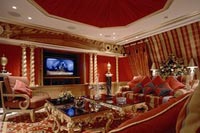
Burj Al Arab
The Royal Suite at the Burj Al Arab in Dubai.

8. Royal Suite, Burj Al Arab, Dubai -- $19,600 per night

Since it was built in the mid-1990s, the Burj Al Arab has become one of the world's most instantly recognizable hotels with its billowing sail-like structure stretching out on an artificial island into the Gulf of Arabia. The Royal Suite on the 25th floor has a marble-and-gold staircase, leopard print carpets, its own private lift and a rotating four-poster canopy bed.

9. Royal Armleder Suite, Le Richemond, Geneva -- $18,900 per night

The Royal Armleder Suite at the Le Richemond Hotel is named after the wealthy family who used to own the famous hotel before Rocco Forte bought it in August 2004. The three-bedroom suite, which stretches over 2,500 sq ft on the seventh floor, has a 1,000 sq ft terrace with panoramic views of Lake Geneva, a real log fire and floor-to-ceiling bulletproof windows. Olga Polizzi, Rocco Forte's sister and well-known hotel interior designer, designed the suite.

10. The Ritz-Carlton Suite, The Ritz-Carlton, Moscow -- $16,500 per night

To stay at the best suite in Moscow's Ritz-Carlton would cost around $16,000 a night -- $500 less than last year. Furnished in Russian imperial style, the 2,370 sq ft suite has views of famous Moscow sites including the Kremlin and Red Square. The suite comes with that necessity for the security-conscious Russian billionaire -- a panic room with its own energy and telecommunications facilities.

Research for this survey was compiled during mid-August. Prices are rate per night including taxes.

From Financial News at www.efinancialnews.com

by Tara Loader Wilkinson

http://finance.yahoo.com/real-estate/article/107608/diplomats-help-boost-rates-at-worlds-most-expensive-hotels.html;_ylt=Aq_1xIX.IoIsrIsvlGPkWXGCfNdF

Hurricane stronger, heads for Mexico's Los Cabos

LOS CABOS, Mexico – Extremely dangerous Hurricane Jimena roared toward Mexico's resort-studded Baja California Peninsula on Monday, prompting emergency workers to set up makeshift shelters and chasing away an international finance conference.

Jimena is just short of Category 5 status — the top danger rating for a hurricane — and could rake the harsh desert region fringed with picturesque beaches and fishing villages as a major storm by Tuesday evening, forecasters said. Heavy bands of intermittent rain moved across the resort town of Los Cabos on Monday evening.

Workers at the Cabo San Lucas marina nailed sheets of plywood on storefront windows while fishermen secured their boats ahead of Jimena, which was packing winds near 155 mph (250 kph). Hotels and restaurants gathered up umbrellas, tables, chairs, and anything else that might be blown away.

At least 10,000 families were ordered to evacuate their homes in low-lying areas and shantytowns, said Apolinar Ledezma, the municipal public safety director.

The government said it would send out 200 military personnel and dozens of police in trucks to help people reach dozens of shelters. Authorities warned that those who refuse to evacuate would be forced to do so.

"We are going to start by inviting people to leave ... the moment will come when we will have to make it obligatory," said Garibaldo Romero, interior secretary for the municipal government.

After official hurricane warnings were broadcast, organizers of an international financial meeting scheduled for Cabo San Lucas this week decided to move their conference — including more than 170 representatives from 54 countries — to Mexico City.

"The meeting has been planned for two months and the meteorological conditions, by their very nature, are unpredictable," said Anthony Gooch, spokesman for the Global Forum on Transparency and Exchange of Information, sponsored by the Paris-based Organization for Economic Cooperation and Development.

Brenda Munoz, who lost her home to a 2001 hurricane, was taking no chances.

"I remember when Hurricane Juliette hit with a lot of intensity. It flattened our home," Munoz said in the vacation town of Cabo San Lucas. This time, she said, "We're already prepared with food and everything so it won't catch us off guard."

As rain started falling Monday morning, Mitch Williams of Orange County, California, waited at the airport to fly home from his vacation.

"The hurricane can do a lot of damage if it hits at that strength," he said.

Williams said poorer residents who live in shacks are not well prepared. "It will wipe them out," he said. His advice for tourists was simple: "Get out."

But on Cabos' famous beaches, some tourists were doing just the opposite, jumping into the Pacific to play in the hurricane's big waves.

The local hotel association estimated that 7,000 tourists were left in Los Cabos. Hotels had a 25 percent occupancy rate, according to the association.

Although city officials shut down the port, lifeguard Roman Dominguez with the Cabo San Lucas Fire Department said there's no feasible way to close a beach.

"We struggle a lot with surfers," he said. "They're looking for waves."

Lifeguards perched in a tower looked on Monday as two women, one with her boogie board, another on a surf board, paddled into pounding surf under cloudy skies.

Clay Hurst, 52, a fencing contractor from Malibu, California, and Ben Saltzman, 28, an emergency medical technician from Pacific Palisades, California, emerged from a swim in the 10-to-12-foot (3-to-4-meter) waves and pounding surf.

"We are waiting anxiously, wanting to be right in the middle of it," said Hurst, who said he has never seen a hurricane as powerful as Jimena.

"We were advised to leave, but we want to be here," he said. "I've always wanted to be in one ... a real bad one."

Saltzman echoed his friend's enthusiasm: "It's an adrenaline rush," he said.

But Cabos San Lucas fishing boat captain Eleazar Unzon, a 30-year veteran of these waters, was more cautious.

"This is causing a lot of fear and concern," said Unzon, 58, as he and helpers pulled the 33-foot (10-meter) fishing boat "Alejandra" onto a trailer. "We're getting the boat out of the water before it hits, so we can rest easy at home."

Unzon acknowledged that big storms do have some benefits — he notes that they bring in the "big fish" coveted by sports fishermen such as marlin — but said, "I'm not going to expose my livelihood."

Tim Donnelly, 57, a boat captain originally from Washington, D.C., sat dockside after tying down the 105-foot (32-meter), two-masted wooden schooner "Sunderland," saying he expected the 140-year-old wooden boat to ride out the storm.

"We've never been hit by a storm of this category," he said. "I'll be shocked if we don't have any problems."

Farther south, Jimena kicked up surf along Mexico's mainland western coast and generated strong winds that bent and uprooted trees in the resort town of Zihuatanejo. Authorities in other mainland towns were setting up shelters as a preventive measure.

By Monday afternoon, Jimena was a Category 4 storm with maximum sustained winds near 155 mph (250 kph) and was moving northwest near 10 mph (15 kph), the U.S. National Hurricane Center in Miami reported. It was centered about 305 miles (495 kilometers) south of Cabo San Lucas.

Hurricanes reach Category 5 at 156 mph (250 kph).

Farther out in the Pacific, Tropical Storm Kevin weakened to a tropical depression with top winds of 35 mph (55 kph). It was centered 845 miles (1,355 kilometers) west-southwest of the Baja peninsula's southern tip.

By MARK STEVENSON

http://news.yahoo.com/s/ap/20090831/ap_on_re_la_am_ca/tropical_weather;_ylt=AsBa3rGcVwE.rQJ2YaVnwOCCfNdF


Wildfire makes menacing advance near Los Angeles

LOS ANGELES – A deadly wildfire that has blackened a wide swath of tinder-dry forest around Los Angeles took another menacing turn Monday as five people became hopelessly trapped inside a smoky canyon and thousands of suburban homes and a vital mountaintop broadcasting complex grew dangerously close to being devoured by explosive, towering flames.

The five trapped people refused to evacuate threatened areas and reported they were stranded at a ranch near Gold Creek, Los Angeles County sheriff's spokesman Steve Whitmore said. A sheriff's helicopter was unable to immediately reach them because of intense fire activity, but would try after the flames passed, he said.

"What this says is, 'Listen, listen, listen,'" Whitmore said. "Those people were told to get out two days ago, and now we are putting our people in danger to get them out."

Fire crews battling the blaze in the Angeles National Forest tried desperately to beat back the flames and prayed for weather conditions to ease. The fire was the largest of at least eight burning across California after days of triple-digit temperatures and low humidity.

The fire scorched 164 square miles of brush and threatened more than 12,000 homes, but the lack of wind kept them from driving stormily into the hearts of the dense suburbs northeast of Los Angeles.

Columns of smoke billowed high into the air before dispersing into a gauzy white haze that burned eyes and prompted warnings of unhealthy air throughout the Los Angeles area. Smoke could be seen billowing around the fabled Hollywood sign.

"It's burning everywhere," U.S. Forest Service spokeswoman Dianne Cahir said. "When it gets into canyons that haven't burned in numerous years, it takes off. If you have any insight into the good Lord upstairs, put in a request."

The exact number of people injured or threatened by the fire was still not clear. Over the weekend, three people who refused to evacuate were burned when they were overrun by flames, including a couple who had sought refuge in a hot tub, authorities said.

Fire crews set backfires and sprayed fire retardant at Mount Wilson, home to at least 20 television transmission towers, radio and cell phone antennas, and the century-old Mount Wilson Observatory. The observatory also houses two giant telescopes and several multimillion-dollar university programs. It is both a landmark for its historic discoveries and a thriving modern center for astronomy.

The fire about a half-mile away was expected to reach the mountaintop sometime Monday night, said Los Angeles County fire Capt. Mark Whaling. If the flames hit the mountain, cell phone service and TV and radio transmissions would be disrupted, but the extent was unclear.

The blaze killed two firefighters, destroyed at least 21 homes and forced thousands of evacuations. The firefighters died when their truck drove off the side of a road with flames all around them.

The victims were fire Capt. Tedmund Hall, 47, of San Bernardino County, and firefighter Specialist Arnaldo "Arnie" Quinones, 35, of Palmdale. Hall was a 26-year veteran, and Quinones had been a county firefighter for eight years.

Quinones' wife is expecting and due to give birth to their first child in the next few weeks.

Hall and his wife have two boys, ages 20 and 21, and was described as a family-oriented man who loved riding motorcycles.

They died fighting a fire that showed no signs of subsiding Monday. People who fled returned to find their homes gone.

"It's the worst roller coaster of my life, and I hate roller coasters," said Adi Ellad, who lost his home in Big Tujunga Canyon over the weekend. "One second I'm crying, one second I'm guilty, the next moment I'm angry, and then I just want to drink tequila and forget."

Ellad left behind a family heirloom Persian rug and a photo album he put together after his father died. "I'm going to have to figure out a new philosophy: how to live without loving stuff," he said.

The blaze in the Los Angeles foothills is the biggest but not most destructive of California's wildfires. Northeast of Sacramento, a wind-driven fire destroyed 60 structures over the weekend, many of them homes in the town of Auburn.

The 275-acre blaze was 50 percent contained Monday afternoon and full containment was expected Tuesday. It wiped out an entire cul-de-sac, leaving only smoldering ruins, a handful of chimneys and burned cars.

Gov. Arnold Schwarzenegger toured the Auburn area, where only charred remnants of homes remained on Monday. At some houses, the only things left on the foundation are metal cabinets and washers and dryers.

"It was embers traveling in the wind, landing on the roofs, landing on attics, getting into that home and burning the home on fire," said Daniel Berlant, spokesman for the California Department of Forestry and Fire Protection.

Some mandatory evacuation orders were lifted, but most residents are still being told to stay away while crews work to restore electricity and hose down embers.

East of Los Angeles, a 1,000-acre fire threatened 2,000 homes and forced the evacuation of a scenic community of apple orchards in an oak-studded area of San Bernardino County. Brush in the area had not burned for a century, fire officials said. Flames burning like huge candles erupted between rocky slopes of the San Bernardino Mountains and the neat farmhouses below.

With highs topping 100 degrees in some areas and humidity remaining low, the National Weather Service extended a weekend warning of extreme fire conditions in the central and Southern California mountains.

Winds were light, which prevented the flames from roaring at furious speed into towns. In 2003, a wind-whipped blaze tore through neighborhoods in San Diego County, killing 15 people and destroying more than 2,400 homes. That fire burned 273,000 acres — or 427 square miles — the largest in state history.

Overall, more than 2,500 firefighters were on the line. More than 20 helicopters and air tankers were preparing to dump water and retardant over the flames. Two Canadian Super Scoopers, giant craft that can pull thousands of gallons of water from lakes and reservoirs, were expected to join the fight later in the day.

In La Crescenta, where the San Gabriel Mountains descend steeply into the bedroom suburb a dozen miles from downtown Los Angeles, 57-year-old Mary Wilson was experiencing her first wildfire after nine years of living in a canyon.

Her family was evacuated twice in the past five days, she said.

"We saw the flames. My daughter got really scared," she said. But she was philosophical: "You have to surrender to the natural forces when you choose to live up here. It's about nature doing its thing."

Also in La Crescenta, dispatchers overnight activated a "reverse 911" system that sent a recorded evacuation warning to people, but it turned out to be a mistake.

Whaling, the L.A. County fire captain, says the message applied to only a small number of residents closest to the fire but instead a large number got the sleep-shattering calls. He said he does not know how many people were involved in the call.

"They pushed the wrong button," he said.

Terry Crews, an actor promoting the new movie "Gamer" on KTLA-TV, talked about being forced to flee two days ago from his home in Altadena, in the foothills above Pasadena. He saw 40-foot flames, grabbed his dog and fled.

"I've never seen anything like it," he said. "I'm from Michigan. I'm used to tornadoes ... but to see this thing, you feel helpless."

"This is like 'The Ten Commandments,'" he said, referring to the movie. "You go, 'holy God, the end of the world.'"

An animal sanctuary called the Roar Foundation Shambala Preserve, six miles east of Acton, was in the mandatory evacuation zone, but fire officials decided removing the animals would be "a logistical nightmare," said Chris Gallucci, vice president of operations.

"We have 64 big cats, leopards, lions, tigers, cougars. ... The animals are just walking around, not being affected by this at all," Gallucci said. "But if we panic, they panic. But we are not in panic mode yet."

___

Associated Press Writers Samantha Young in Auburn, Tracie Cone in Fresno, and Raquel Maria Dillon and Solvej Schou in Los Angeles contributed to this report.

By JOHN ANTCZAK

http://news.yahoo.com/s/ap/us_wildfires

Daily aspirin may do more harm than good: study

Researchers found that the risks of bleeding from taking aspirin were such that its routine use in healthy people "cannot be supported" -- although they did not dispute its use in patients with a history of vascular problems.

The results of the Aspirin for Asymptomatic Atherosclerosis (AAA) study add to a long-running debate about whether the potential dangers of taking aspirin could outweigh the benefits from reducing the risk of clots.

"We know that patients with symptoms of artery disease, such as angina, heart attack or stroke, can reduce their risk of further problems by taking a small dose of aspirin each day," said Professor Peter Weissberg, medical director of the British Heart Foundation which helped fund the research.

"The findings of this study agree with our current advice that people who do not have symptomatic or diagnosed artery or heart disease should not take aspirin, because the risks of bleeding may outweigh the benefits."

The study was led by Professor Gerry Fowkes from the Wolfson Unit for Prevention of Peripheral Vascular Diseases in Edinburgh, Scotland, and presented at the European Society of Cardiology Congress in Barcelona Sunday.

It involved 3,350 men and women aged 50 to 75 years who tests revealed may have a condition where the arteries in their legs were furred up -- but who had no symptoms of heart disease or history of heart attack.

They were given either a daily 100 mg dose of aspirin or a placebo (a dummy pill) and monitored over eight years.

While there was no difference in the number of heart attacks, strokes and other cardiovascular events suffered, major bleeding occurred in two percent of the aspirin group compared to just 1.2 percent of the placebo group.

By AFP

http://health.yahoo.com/news/afp/healthresearchheartbritain_20090831130209.html